• Skip to secondary menu
  • Skip to main content
  • Skip to primary sidebar
  • Skip to footer
  • Home
  • About
    • Email Me
    • Disclosure & Copyright
  • Start Here
  • Subscribe
  • Privacy Policy
  • Books for Moms

Creative Family Fun

Your one-stop shop for kids activities and family fun

  • Facebook
  • Instagram
  • Pinterest
  • Twitter
  • Spelling Activities
  • Family Fun
  • STEM
  • Movie Night
  • Toddler Activities

Science Activities for Kids

Stop Summer Slide While Learning in the Garden

May 25, 2016 By Terri Thompson

Are your kids out of school yet for the summer? We’ve still got a couple of weeks to go, but I’m already getting ideas for summer learning. We like to keep the learning going all summer long in order to stop summer slide in its tracks. And, what better way to learn than to take advantage of all that summer has to offer by learning in nature.

If you’ve ever grown a garden in the summer, you’ve seen what a great learning experience it can be. Simply planting a seed and watching it grow can teach a child so much. Have you ever thought about extending that learning?

Get out in the garden this summer. Look for bugs, observe some worms, explore the plants from bottom to top. Keep learning this summer while doing some science in the garden with one of these activities.
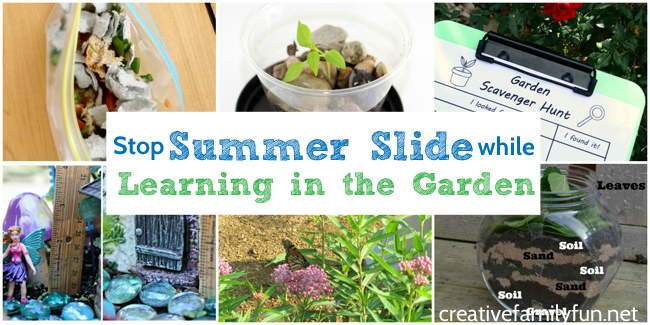
Stop summer slide with some fun and educational learning activities you can do in the garden. Grow seeds, observe bugs, and do more science in the garden.

Disclosure: There are Amazon Affiliate and other affiliate links in this article which means, at no additional cost to you, we could receive compensation for our recommendations. You can read our full disclosure policy on our Disclosure Page for more details.

Learn With Plants

Observe a plant from seed to harvest. Try planting one of these Quick Growing Seeds for Kids at Rainy Day Mum to see the growing process.

Combine literacy and gardening by planting a book-inspired garden. Kitchen Counter Chronicles has plans for gardens inspired by Peter Rabbit and Growing Vegetable Soup.

Track how long it takes your plants to grow. You can track your results with this free printable garden log at Teaching Mama.

Which garden environment will help a specific plant grow the best. Try this plant science experiment from Inspiration Laboratories to find out.
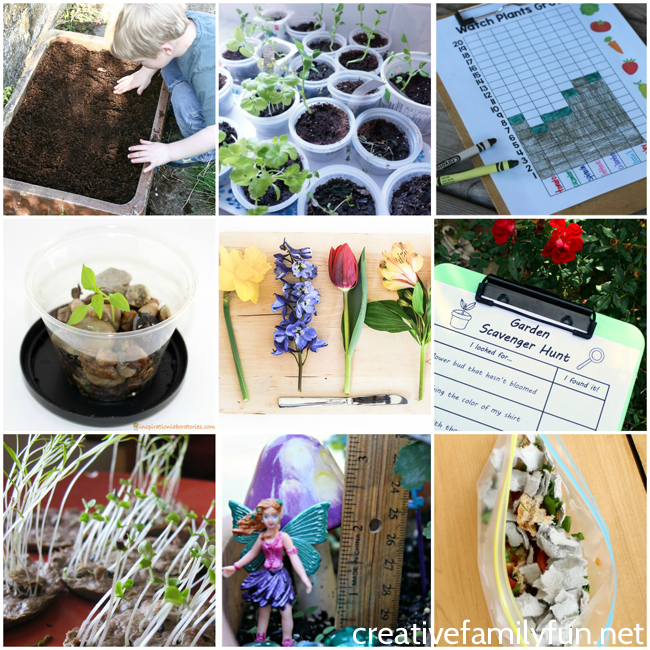
Stop summer slide with some fun and educational learning activities you can do in the garden. Grow seeds, observe bugs, and do more science in the garden.

Learn about the parts of a flower by taking one apart. Try this simple Dissecting Flowers lesson from Playful Learning.

Have a little fun and use your observation skills with this fun Garden Scavenger Hunt from Fantastic Fun and Learning.

Sprout seeds in a unique way by making your own Seed Paper from Outdoors Mom.

There are so many ways to learn with a fairy garden. EdVentures With Kids has some great ideas for STEM Activities in your Fairy Garden.

Can you turn food scraps into soil? Observe the process of composting with this Sandwich Bag Compost activity at CBC Parents.
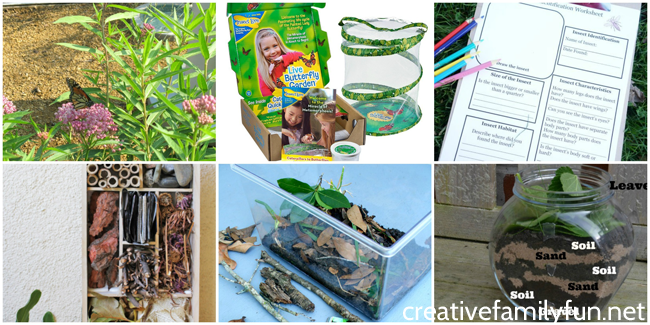
Tiny Creatures in the Garden

Add some elements to your yard to attract butterflies so you can observe them all summer long. Outdoors Mom has all the hints you need.

Raise your own butterflies. This kit from Insect Lore has everything you need to observe the transformation of a caterpillar to a butterfly.

Observe the insects that live in your garden. Kitchen Counter Chronicles has a great Insect Investigation Worksheet to help guide your observations.

Attract those insects to your garden by building an insect hotel. Find the instructions at Babble Dabble Do.

Build a habitat for roly polys (pill bugs). I was so fascinated with these little creatures when I was a kid. Wouldn’t it be fun to really observe them? Find all the details at Fantastic Fun and Learning.

Worms are an important part of a healthy garden. Have some fun observing worms by building a wormery. Science Sparks will show you how.

Stop summer slide before it starts by planning some fun learning activities in the garden. Which one do you want to try?
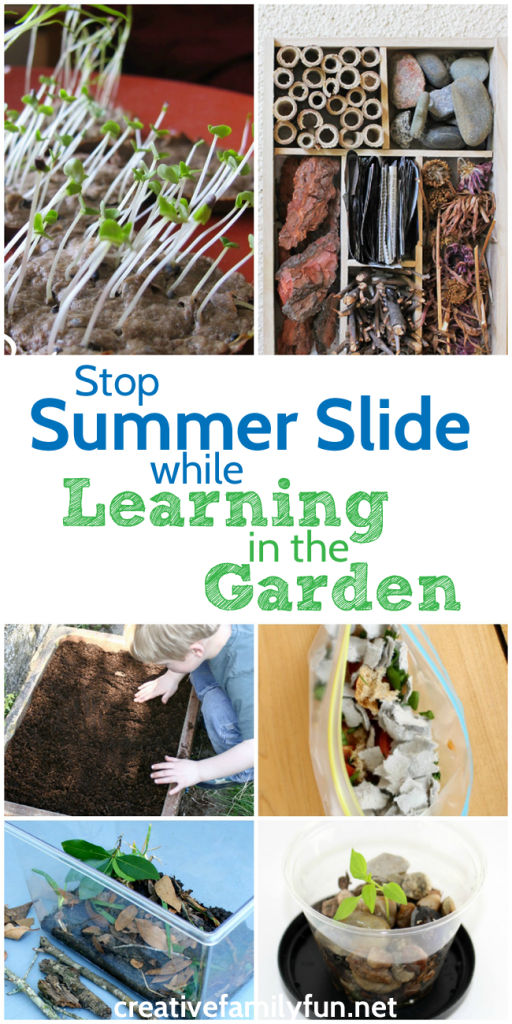
Stop summer slide with some fun and educational learning activities you can do in the garden. Grow seeds, observe bugs, and do more science in the garden.

You may also like one of these nature activities:

Family Bird Watching Club

10 Ways to Learn About Animals

Explore Nature: Leaf Collections

10 Ways to Learn About Birds

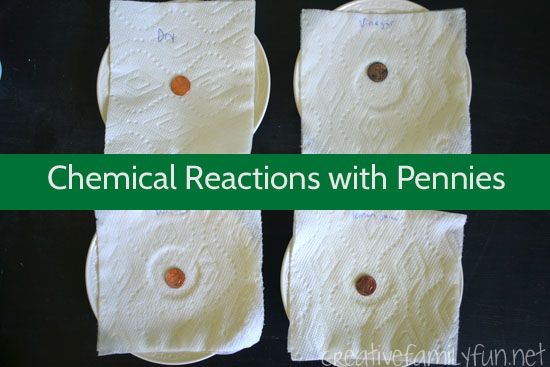
Chemical Reactions with Pennies

September 24, 2015 By Terri Thompson

What is a chemical reaction?

It is the change of a substance into a new one that has a different chemical identity.

My kids were completely fascinated when we decided to explore this at home with these safe chemical reactions with pennies.

This fun science project for kids will help them explore chemical reactions with pennies.

I know this sounds very high school chem lab-ish and like something that should require a full range of safety equipment, but I’ve got a fun science project that’s completely safe to do at home with no special equipment required.

(Although, feel free to wear the safety goggles. They’re kind of cool!)

Grab some supplies and let’s explore chemical reactions with pennies.

Disclosure: This post contains Amazon Affiliate links. Please see my Disclosure Page for more details.

This fun science project for kids will help them explore chemical reactions with pennies.

Supplies Needed

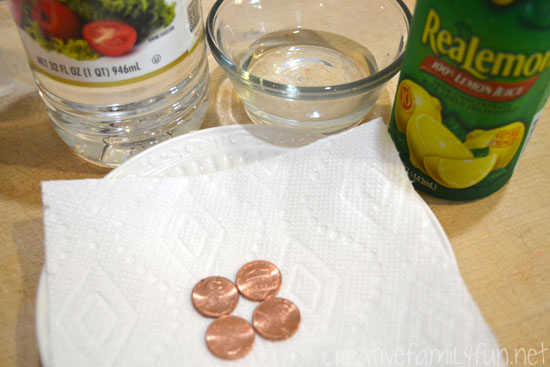
4 shiny pennies (make sure they are all as shiny as possible)
4 paper towels
White vinegar
Lemon juice
Water
4 saucers or bowls
My Science Experiment recording sheet(optional)

This fun science project for kids will help them explore chemical reactions with pennies.

Prepare Your Experiment

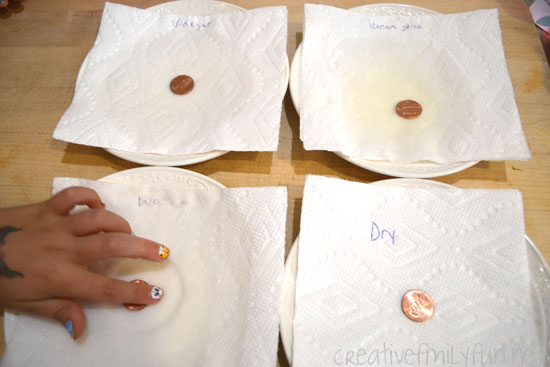
To set up your experiment, fold and place a paper towel on top of each saucer (or bowl).

Next pour water on one paper towel, lemon juice on the next, and white vinegar on another. Leave one paper towel dry.

Place one penny in the middle of the wet area of each of your paper towels. Use a pen to label each paper towel.

To guide us through our experiment, we used our My Science Experiment sheet. (You can click the link to download and print your own copy.)

We started with our question: What will make a penny turn a different color? Then we made our predictions. We each chose the substance we thought would turn our penny green.

We recorded our different substances: water, white vinegar, and lemon juice, while also noting that we left one paper towel dry. It was to serve as our control – the one penny we didn’t make any changes to so that we could use it as comparison later.

This fun science project for kids will help them explore chemical reactions with pennies.

The results of our chemical reactions with pennies experiment

It was hard, but we waited 24 hours for our experiment to work.

We checked on our pennies after about 12 hours and refreshed the liquid every so often.

Your paper towels will dry out, so be ready to add more liquid to keep them wet.

After 24 hours, we took a good look at our pennies. The results surprised even me!

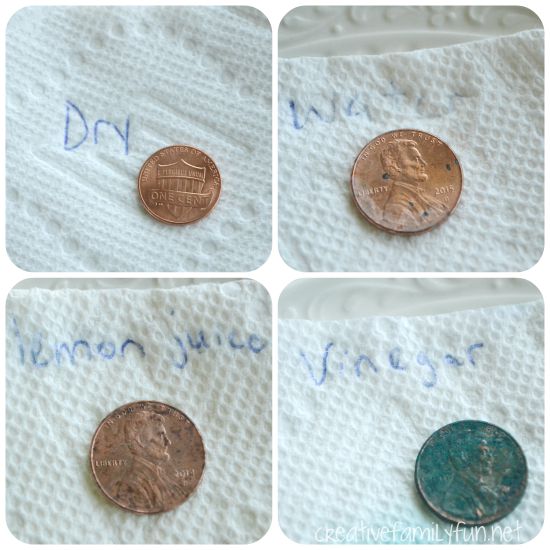
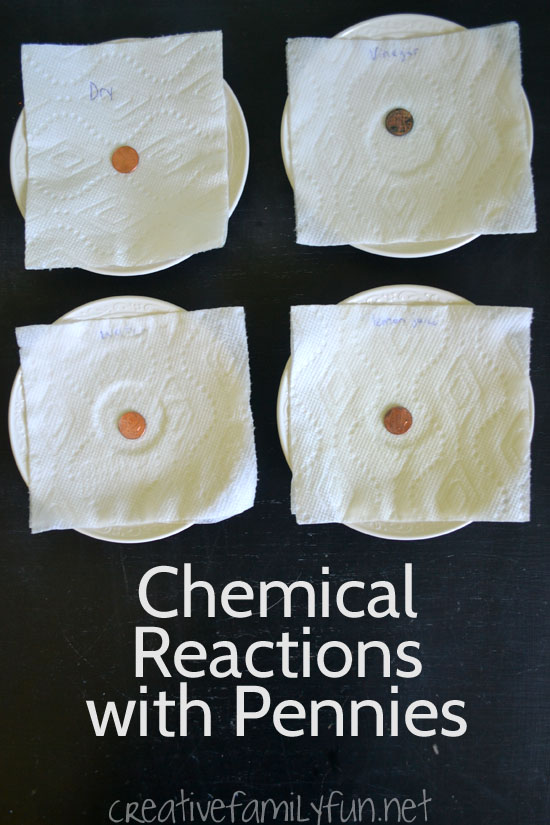
I knew the vinegar would turn the penny green. Check it out in the collage above. But, I was a bit surprised to see the results of the other liquids.

Water did change the penny; it left it looking dull, worn, and caused a few black dots to form.

Lemon juice ate away at the penny making it look worn away (similar to a penny that has been run over by a car a few times).

The penny in vinegar turn green, both on the side exposed the liquid and the side exposed to the air.

And finally, the dry penny did not change at all. Interesting results!

Why did the penny turn green in vinegar?

The combination of the vinegar and air caused a blueish green substance called malachite to form on the penny. This is the same substance that has turned the Statue of Liberty green.

This fun science project for kids will help them explore chemical reactions with pennies.

Have fun doing this fun (and safe) chemical reaction with pennies experiment with your kids!

You may also like one of these science experiments:

Hot Chocolate Science

Hockey Science

Melting Crayons Science Experiment

Christmas Science – Grow the Grinch’s Heart

Our 2nd grade blogging squad has been hard at work creating fun projects about money.

Here are some other great Money activities for your 2nd graders:
Money Activities for Second Grade from Look! We’re Learning!
Money Math Problems for 1st-3rd Grade from Planet Smarty Pants
Counting Coins Scavenger Hunt from School Time Snippets
Skip counting nickels and dimes from Sugar Aunts
Free Money Fractions and Probability Activity from Life Over C’s
Currency Collections from Rainy Day Mum

Hands-On Flower Diagram

May 16, 2013 By Terri Thompson

I’d like to share another fabulous guest post today. Please welcome Ashley from Me & Marie Learning.

With Spring in full swing, we are seeing flowers everywhere!

I wanted to help my young learners visualize the process of how a flower grows.  Among many other activities, we created a Hands-On Flower Diagram.  We talked about what a diagram is and how it helps us learn.  The best part about this diagram is that it uses materials you most likely already have on hand!

Disclosure: There are Amazon Affiliate and other affiliate links in this article which means, at no additional cost to you, we could receive compensation for our recommendations. You can read our full disclosure policy on our Disclosure Page for more details.

Start by gathering the following materials:

Straws
Brown yarn or string
Cupcake liner
Seeds (You could use sunflower seeds or any seeds you have.  I only had lima beans!)
Leaf cutout or real leaf
Diagram labels (You can print them off here.)
Construction paper
Glue and tape the materials to create a diagram, just like in the pictures below.

Help children understand the function of each part of the flower.  For example, just like a straw, the flower’s stem sucks water up from the roots.  Work through each part of the flower and add labels after discussing the functions.

Now, when your children see real flowers within pots or in the ground, they will know exactly how the parts of that flower works!

***********************************************

Thank you Ashley for such a fun project!

Ashley is the owner of Me & Marie Learning, a blog all about early learning.  She has taken some time off teaching in a traditional setting to be at home with her young children. Ashley is now an in-home childcare provider, teaching her own and other children in her preschool room.  Ashley has a degree in Elementary Education and Early Childhood Education with a Master’s Degree in Reading and Literacy.

Messy Fun with Goop!

April 10, 2013 By Terri Thompson

Goop, also called oobleck, was a new experience for us.

It was inexpensive, easy to make, very mess, and a whole lot of fun!

Disclosure: There are Amazon Affiliate and other affiliate links in this article which means, at no additional cost to you, we could receive compensation for our recommendations. You can read our full disclosure policy on our Disclosure Page for more details.

Supplies Needed:
Corn starch
Water
Plastic bin

We set up on the kitchen floor; you really don’t want to do this in a carpeted area.

I found an empty plastic bin and dumped a whole box of cornstarch in it. I let the girls feel the cornstarch to see how soft it was.

Then we started adding our water.

Mix it up as you’re adding water. We just used our hands for mixing.

Add the water until it’s a soft liquid, about the consistency of honey.

Now it’s time for fun.

Squish it quickly with your hands; it feels solid and crumbly.

Run your hands slowly through it; now it feels liquid.

Grab a handful and squish it like a ball. Now, open your hands and watch it flow slowly out.

Goop is an interesting mixture that is both a solid and a liquid.

After playing for awhile, we added a bunch of old kitchen tools from our sandbox. We had whisks, scoops, and measuring spoons.

Try whisking quickly. It’s hard to do!

They loved the sensory experience and spent a lot of time pouring it on their arms.

The goop did make a massive mess. But, it does clean up easily. I was able to sweep it off my kitchen floor once it had dried. Also, it came off their clothes with a simple washing.

The Science Behind Goop

The mixture of cornstarch and water is a suspension.

The two substances combine, but will eventually separate again. Another example of a suspension is muddy water.

The viscosity, or thickness and resistance of flow, of this mixture reacts to force. So, when you quickly grab a handful, the cornstarch particles temporarily trap the water particles. When you release, the mixture turns to liquid again.

You can read this post at Steve Spangler Science about cornstarch science for a more detailed explanation.

Have you ever made goop? It’s a fun science and sensory experience.

10 Science Experiments for Preschoolers

January 10, 2013 By Terri Thompson

Science experiments for preschool

Science is a big deal at our house.

My girls love it and my oldest even considers herself a scientist. It’s easily her favorite subject in school and she’s only in Kindergarten.

I’ve compiled a list of 10 fabulous science experiments for preschoolers, which are also appropriate for early elementary-aged kids.

They’re great choices for kids who love science already or for showing them that science can be a whole lot of fun.

We have already tried some of these and others are on my list of experiments I want to try. I know you’ll want to try these out with your kids too!

Disclosure: There are Amazon Affiliate and other affiliate links in this article which means, at no additional cost to you, we could receive compensation for our recommendations. You can read our full disclosure policy on our Disclosure Page for more details.

1. Baking Soda & Vinegar: This classic and safe chemical reaction is always a hit with preschoolers. We’ve created a volcanic reaction and had a blast. Stop by Mom to 2 Posh Lil Divas for instructions on how to make a big bubbly volcano.

2. Tornado in a Bottle: If you’re looking for a fun weather-related experiment, this should fit the bill. We haven’t done this one yet, but I want to! Weather Wiz Kids has all the instructions you need to make a tornado in a bottle.

3. Plant a Seed: Is there anything more fascinating that watching a seed grow? Teach Preschool shows you how to make a simple greenhouse to hang in your window. It’s the perfect way to watch the stages a seed goes through before it pops out of the ground.

4. Will it Sink or Will it Float?: You can do this with a variety of household items and a sink full of water. Which ones will sink and which ones will float? Ask your kids this question and help them think critically through the scientific process. Tinkerlab has a great version of this experiment with an egg using fresh water and salt water. Looks like fun!

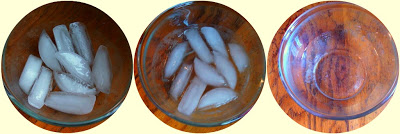
5. Learn About the Stages of Matter with Ice: We did this experiment and the girls were completely fascinated by watching ice melt. Have them figure out if they can turn the water back into ice.

6. Make a Cloud: I love this colorful experiment shared on Reading Confetti. It’s a great introduction to clouds and rain and I’m sure every kid would be fascinated by the results.

7. Siphon Water: How does water move? Not Just Cute shares an easy experiment you can do to help your kids start to understand a complicated science term. We’re going to try this one soon!

8. Ivory Soap Explosion: Do you know what happens when you put Ivory Soap in the microwave? The results are amazing! Mom to 2 Posh Lil Divas shows you how do this fun experiment. We’ve done it before and loved the results. And the added bonus is that you’ll end up with a fun sensory element to play with!

9. Learn How Sound is Made: Your kids know what sound is and I bet they are good at making loud noises, but do they know how sound is made? Kids Activities Blog shows you how to do a fun experiment to learn all about sound.

10. Diet Coke & Mentos: You may have seen this on Myth Busters and may have wanted to do this experiment yourself. Guess what? We have and it’s fun. For this experiment, you’ll need plenty of adult supervision, but it’s very easy to do. You can find all the details at Steve Spangler Science. You should also watch their video to see just how much fun this is.

Bonus Activity ~ See How Water Travels Through a Plant: All if takes is a couple of stalks of celery, some colored water, and time, and you can see yourself how a plant absorbs water. Rainy Day Mum shows you how to do this fascinating experiment.

Preschool science experiments

Make this a family adventure: 

Science experiments are always a fun choice for family time. For a successful family adventure, make sure you have gathered all the supplies ahead of time. Read and become familiar with the instructions, so you can lead the kids through the process with ease. Also, plan which steps the adults will be in charge of and which the kids can do. All the projects listed above would be perfect for a science family adventure.

  • « Go to Previous Page
  • Page 1
  • Interim pages omitted …
  • Page 3
  • Page 4
  • Page 5
  • Page 6
  • Go to Next Page »

Primary Sidebar

Footer

Categories

Archives

Copyright © 2026 · Designed by The Blog Surgery

Creative Family Fun uses cookies to improve your experience. These cookies provide feedback to our analytics and advertisers. We use the information to track views of the site, where you go and to know if you are a regular visitor or brand new as well as provide a personalized experience where possible. We'll assume you're ok with this, but you can opt-out if you wish.Accept Reject Read More
Privacy & Cookies Policy

Privacy Overview

This website uses cookies to improve your experience while you navigate through the website. Out of these, the cookies that are categorized as necessary are stored on your browser as they are essential for the working of basic functionalities of the website. We also use third-party cookies that help us analyze and understand how you use this website. These cookies will be stored in your browser only with your consent. You also have the option to opt-out of these cookies. But opting out of some of these cookies may affect your browsing experience.
Necessary
Always Enabled
Necessary cookies are absolutely essential for the website to function properly. This category only includes cookies that ensures basic functionalities and security features of the website. These cookies do not store any personal information.
Non-necessary
Any cookies that may not be particularly necessary for the website to function and is used specifically to collect user personal data via analytics, ads, other embedded contents are termed as non-necessary cookies. It is mandatory to procure user consent prior to running these cookies on your website.
SAVE & ACCEPT