• Skip to secondary menu
  • Skip to main content
  • Skip to primary sidebar
  • Skip to footer
  • Home
  • About
    • Email Me
    • Disclosure & Copyright
  • Start Here
  • Subscribe
  • Privacy Policy
  • Books for Moms

Creative Family Fun

Your one-stop shop for kids activities and family fun

  • Facebook
  • Instagram
  • Pinterest
  • Twitter
  • Spelling Activities
  • Family Fun
  • STEM
  • Movie Night
  • Toddler Activities

STEAM Activities

Marshmallow Engineering STEAM Building Challenge

June 25, 2014 By Terri Thompson


We got down to the basics recently with a STEM activity that is perfect for summer learning (or anytime), Marshmallow Engineering.

Why is it perfect?

It uses only a few supplies, it requires no prep time, it keep your kids’ brains working, and it doesn’t look at all like learning. (It’s also a perfect activity to use up that stale bag of mini marshmallows you found in the back of the cupboard!)
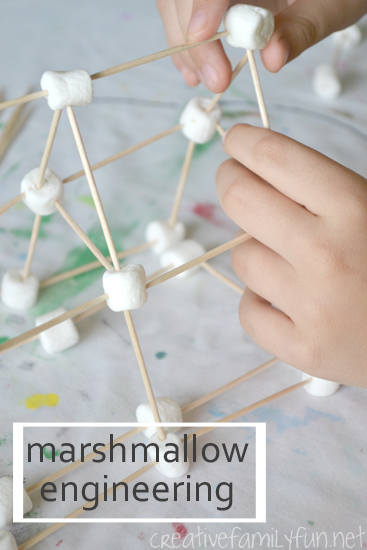
Marshmallow Engineering: a fun STEM activity using only marshmallows and toothpicks #STEM #engineering #CreativeFamilyFun

Disclosure: There are Amazon Affiliate and other affiliate links in this article which means, at no additional cost to you, we could receive compensation for our recommendations. You can read our full disclosure policy on our Disclosure Page for more details.

Supplies Needed

Mini Marshmallows (stale ones work the best)
Toothpicks
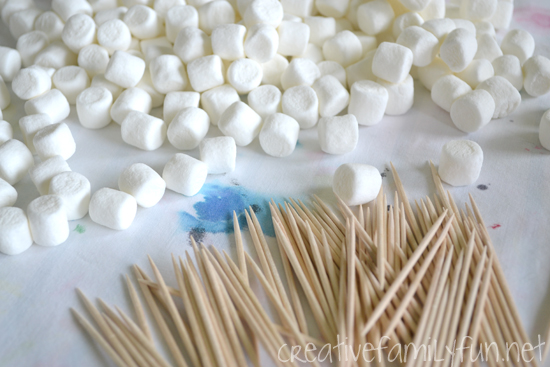
Building with marshmallows and toothpicks is not a new idea.

It would probably have a place in the kids activities hall-of-fame… if there was one.

In fact, this is a staple activity in my daughters’ STEM school.

The concept couldn’t be simpler. Give the kids a pile of marshmallows and a pile of toothpicks and let them build. That’s it.
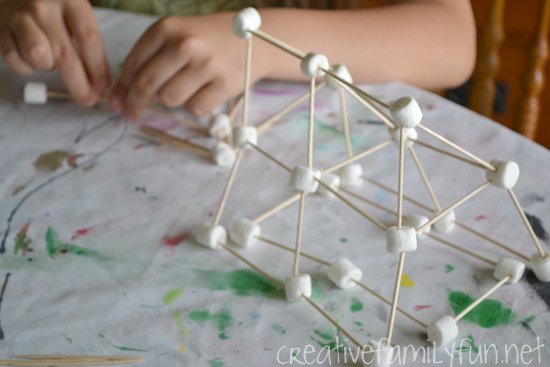
Building Challenges

If you wanted to add a little extra to the project, you could challenge your kids to build specific items such as building a bridge or building a chair.

But, I love this project best at it’s most basic. Just let them build.

I gave no instructions. I just dumped the stale bag of marshmallow on the table, gave my kids a box of toothpicks, and told them they could build.

My 2nd Grader took off immediately. This was a familiar activity for her. She got an idea in her head for what she wanted to build and got started. My Kindergartner was a little unsure at first, but soon got the hang of it.
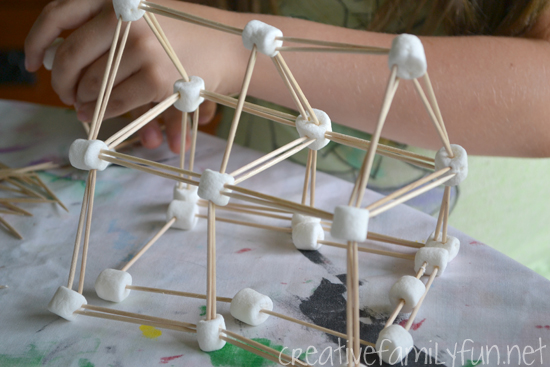
The advantages of marshmallow engineering

You know what’s so great about this? The critical thinking that’s involved.

My 2nd Grader tried to make a campsite, but her tent kept falling down. She kept working and working to stabilize the tent. Eventually, after doubling up the toothpicks and adding cross beams, she got it to work.

That’s why we do these projects. Not only is it fun, but the critical thinking skills they need to build continue to get exercised during summer break.
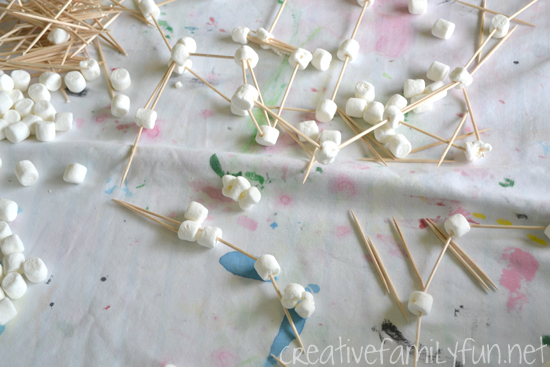
Can you see the aftermath above? Yes, that was the end of a long afternoon of building. This activity has been requested again and again. I’ll have to see if I have any more stale bags of marshmallows.

Have you ever built with toothpicks and marshmallows?

Make This a Family Adventure

Cost: A few dollars for toothpicks and marshmallows. Even less if you already have the supplies at home.

Planning time: None, once you have the supplies

Ages: 5 and up

Time Needed: 30 minutes or longer

Notes: Marshmallow engineering is a great STEM activity for the kids, but tweens, teens, and adults can have fun with it too. Gather all ages around the table and work together. Build a huge collaborative project or just enjoy each other’s company while you build your own projects.
Get down to the basics with this simple STEAM building challenge, Marshmallow Engineering. It's fun, open-ended, and a great way to learn. #STEM #engineering #CreativeFamilyFun

You might enjoy one of these STEM projects:

Melting Crayons Science Experiment

Science + Art: Color Mixing Top

Hot Chocolate Science

Building Structures with Candy Gumdrops at Lemon Lime Adventure
Sink or Float?

June 10, 2014 By Terri Thompson

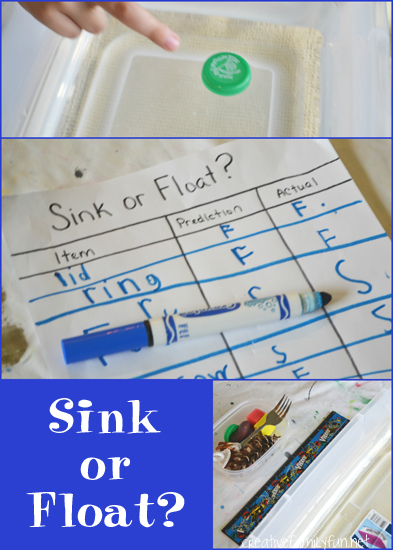
Summer is in full swing around here, but that doesn’t mean we’ve shut off our brains. We’ve got plenty of outdoor play, plenty of free play, and plenty of reading. But, we’re also planning plenty of fun (emphasis on fun) learning activities. This easy sink or float experiment helped us brush up on our science skills and also added some real-life writing practice.

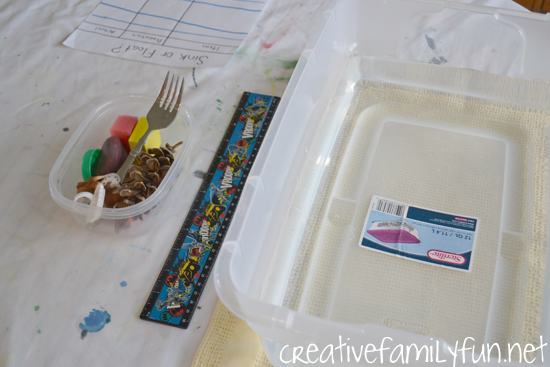
I set the stage with a large tub of water. This plastic container was perfect. I also went around the house and found several things that we could test. Go through your junk drawer or art supplies for some fun ideas. Just make sure the water won’t hurt it. I found a plastic ruler, a fork, piece of sponge, plastic ring, bottle cap, rock, pine cone, nickel, and foam block. Try to find a good selection of both floating or sinking items.

Disclosure: There are Amazon Affiliate and other affiliate links in this article which means, at no additional cost to you, we could receive compensation for our recommendations. You can read our full disclosure policy on our Disclosure Page for more details.

Before beginning our experiment, we made a simple chart. We had a columns for our items, our predictions, and the actual outcome. The girls took turns choosing one item at a time. They would pick an item, write down the name, and make their prediction. Then, it was time to see the actual results. It turned out that our prediction skills were spot on. And, it wasn’t just lucky guesses, the girls could explain why they chose sink or float.

This is an easy science project and it may be one that your child has already done in school. (My oldest daughter did.) But, it’s a good one for practicing those observation and prediction skills that are so important for young scientists. Adding the chart element also gave us a chance to practice our writing, a skill that needs to be second nature.

Adapt this for younger children: This project can also be done with pre-writers. Set the invitation the same way, but skip the chart. You can keep the chart for them if you want that element. Otherwise, just choose one item, make a prediction, and then find your results. It’s a great way to introduce prediction to your younger kids.

Have you ever done this experiment?

Are you looking for fun science ideas for preschoolers? Check out Three to Five: Playful Preschool for science ideas and more. Click here for purchasing information.

https://www.creativefamilyfun.net/2014/05/three-to-five-playful-preschool.html

Science + Art: Craft Stick Bracelets

September 4, 2013 By Terri Thompson

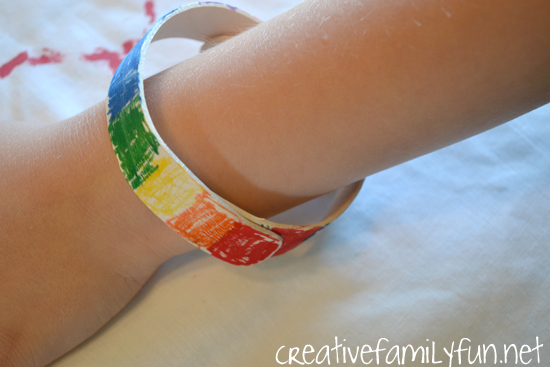
Combine science and art to create this fun STEAM activity for kids, craft stick bracelets. Do a simple science experiment to bend your craft sticks and then decorate your new bracelet.

We once again combined art with science to make these fun craft stick bracelets.

How do you get a craft stick to bend without breaking? Can you transform it into a new shape?

We answered these questions with a fun experiment.

Combine science and art to create this fun STEAM activity for kids, craft stick bracelets. Do a simple science experiment to bend your craft sticks and then decorate your new bracelet.

Disclosure: There are Amazon Affiliate and other affiliate links in this article which means, at no additional cost to you, we could receive compensation for our recommendations. You can read our full disclosure policy on our Disclosure Page for more details.

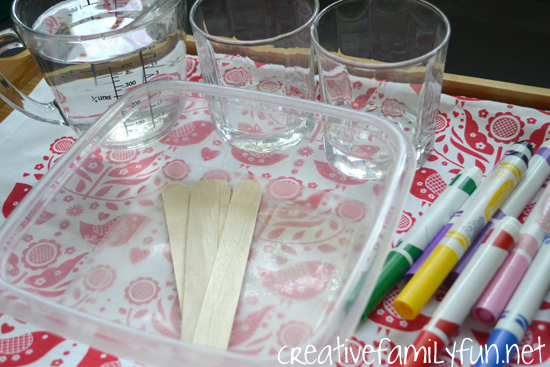
Supplies Needed:

Craft sticks
Container large enough to hold your craft sticks flat
Water
Drinking glass
Markers, washi tape, paint (or whaterever you want to use to embellish your bracelets)

Combine science and art to create this fun STEAM activity for kids, craft stick bracelets. Do a simple science experiment to bend your craft sticks and then decorate your new bracelet.

Before beginning, we examined our craft sticks.

Do they bend? Not without breaking!

The dry wood is hard and strong, exactly why we use it for a building material. But, we can make them flexible.

Historically, steam has been used to bend wood for tool making, boats, musical instruments, furniture and more. We were able to get the same effect with boiling water.

Here’s how we did it:

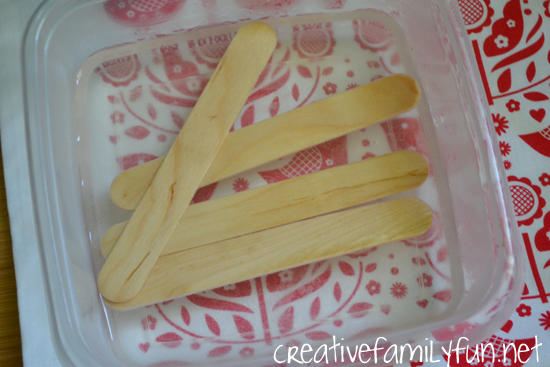
Place your craft sticks flat in a container. We just used a plastic storage container.

Set this container someplace where you won’t need to move it for awhile.

Next, and it’s very important that a grown-up does this part, pour hot, boiling water over the sticks until they are submerged. You’ll need to leave them alone for 30-45 minutes. You may want to soak more craft sticks than you actually need to allow for mistakes.

Combine science and art to create this fun STEAM activity for kids, craft stick bracelets. Do a simple science experiment to bend your craft sticks and then decorate your new bracelet.

Once your craft sticks have soaked for at least 30 minutes, it’s time to get them out and try to bend them.

I emptied the water and we started testing our sticks. We found them much more flexible than when they were dry.

But, we did discover that if you tried to bend them too quickly, the sticks would still break. Our discovery was that we needed to bend them slowly and gradually.

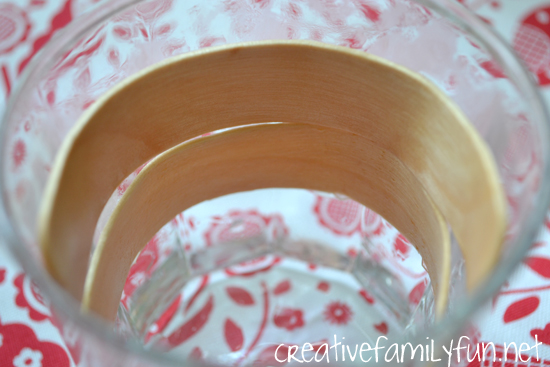
Once we did that we placed them inside our drinking glasses to mold them. We left them in the glasses overnight to dry. Once they are dry, they will hold the curve shape.

Combine science and art to create this fun STEAM activity for kids, craft stick bracelets. Do a simple science experiment to bend your craft sticks and then decorate your new bracelet.

After pulling our sticks out of the glasses and marveling at their new shape, we decorated them to wear as bracelets.

The girls discovered they they could fit two curved sticks together to form a circle and make a perfect bracelet. It was fun and amazing to try to bend wood!

Have you ever tried this experiment? How did it work out for you?

Make This a Family Adventure

Cost: Under $5.00. Free if you already have craft sticks at home
Planning Time: 10 minutes (or less). You will need to gather your materials and boil your water.
Ages: Ideal for 5 years and up. Younger children can participate and have fun as long as parents are involved
Time Needed: 1 hour needed for first step, which included about 30-45 minutes of soaking time. The craft sticks will need to dry overnight and then you will need about 20-30 minutes for decorating.
Note: Because this project requires drying overnight, plan this for a time when you will be able to have family time two days in a row. It’s a very fascinating project that even adults will like to do, so it is well worth the time spent.

Colored Ice Fun

June 6, 2013 By Terri Thompson

I can’t imagine anything more fun and refreshing on a hot summer’s day than playing with ice. So, grab some fun ice cube trays and create some colored ice cubes (or sticks) for some creative fun.

Disclosure: There are Amazon Affiliate and other affiliate links in this article which means, at no additional cost to you, we could receive compensation for our recommendations. You can read our full disclosure policy on our Disclosure Page for more details.

Today I’m happy to welcome Ana from Babble Dabble Do to this space with a fun ice play activity perfect for summer. While you guys are reading this, I’m going to head out to the store to buy some of these fun ice cube trays! Take it away Ana…

Make some simple colored ice to use for creative activities, sensory play, STEM experiments, art projects and more. Colored ice is such a fun tool to use!
Disclosure: This post contains Amazon Affiliate links. Please see my Disclosure Page for more details. 

Hi there, I’m Ana from Babble Dabble Do and I’m excited to be guest posting on Creative Family Fun today!

With summer finally here I’ve been itching to play with ice as a “cool” outdoor activity for the kids. If you’ve been to my blog you know I’m obsessed with color, and food coloring is something I use on a regular basis in our projects.  This week I thought it would be fun to experiment with colored ice and see what interesting activities we could come up with!

Make some simple colored ice to use for creative activities, sensory play, STEM experiments, art projects and more. Colored ice is such a fun tool to use!

Materials:

Water
Food Coloring
Cups/Bowls
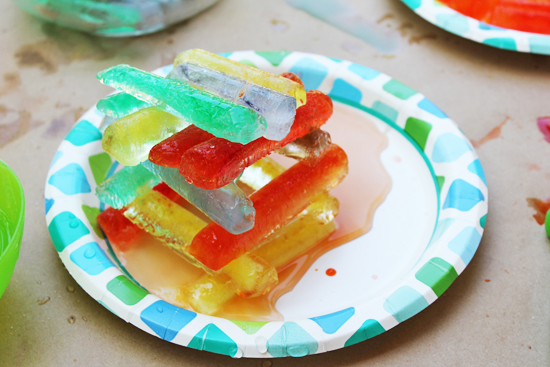
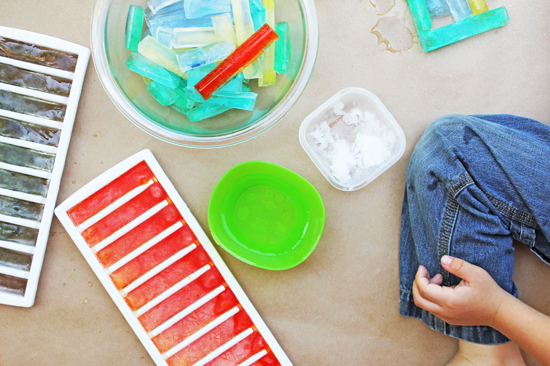
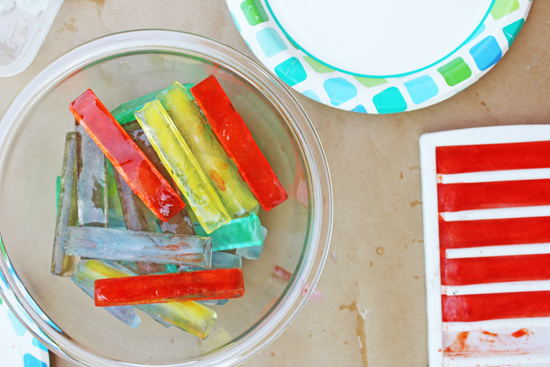
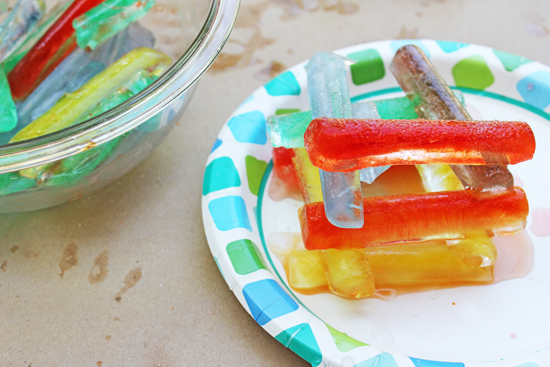
Ice cube trays and/or different molds- I used trays that make ice sticks for water bottles. The pieces of ice were like logs, perfect to build and draw with!
Salt and salt shaker
Shaved ice (optional)– use a snow cone maker to make it
Small plates
Spoons or eye droppers
Paper

Make some simple colored ice to use for creative activities, sensory play, STEM experiments, art projects and more. Colored ice is such a fun tool to use!

You’ll need to factor in a little prep time for these activities because you have to freeze things in advance BUT a few minutes of freezing the day before is all you need. Using food coloring, tint several glasses of water with different colors and pour into ice
cube tray molds. Freeze overnight or for several hours.

Building:

Stack your ice cubes on top of one another to try and make a structure. Using drops of water and shaved ice, “glue” the pieces of ice together. “Gluing” only worked for us about half the time. When finished, carefully move the sculpture back into the freezer to fuse it together! If you plan on refreezing, use a sturdy tray underneath the sculpture as too much movement will cause it to break apart.

Make some simple colored ice to use for creative activities, sensory play, STEM experiments, art projects and more. Colored ice is such a fun tool to use!

Salt and Ice Experiment:

I don’t think the interaction of salt and ice ever gets old to watch. Give your child a salt shaker and let them sprinkle salt on the
ice to make holes and give it texture.

Color Mixing:

Using red, blue, and yellow ice sticks and three different bowls, encourage your child to experiment with color mixing. Let them melt two colored ice sticks in the same bowl to make a magical new color appear!

Water Table:

They might not last long in the blazing heat, but colored ice would make a fun addition to a water table.

Drawing with Ice:

You’ll need to use a strong concentration of color for this one to work well; use the ice sticks like crayons to color on paper.

Melting Artwork:

Place several ice sticks on a piece of white paper and let them melt to make a free form painting.

Open-ended Play:

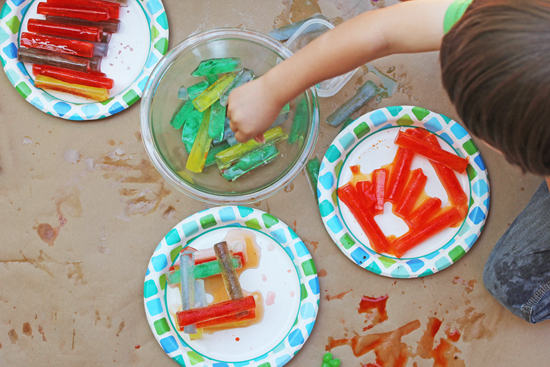
I had originally planned to make only ice sculptures but when I gave my kids the ice sticks they had ideas of their own! They stacked and sorted them and just loved the sensory experience of playing with a cold material.

Make some simple colored ice to use for creative activities, sensory play, STEM experiments, art projects and more. Colored ice is such a fun tool to use!
Ana Luisa Dziengel is an architect, award winning furniture designer, and creatively inspired mom making magic with her three kids in sunny Los Angeles!
Web: http://babbledabbledo.com/
FB: https://www.facebook.com/pages/Babble-Dabble-Do/206167262806000
Twitter: https://twitter.com/BabbleDabbleDo
Pinterest: http://pinterest.com/babbledabbledo/

You may also like one of these activities:

Ice Play

Color Mixing Lab

Indoor Color Scavenger Hunt

Recycled Robots

April 11, 2013 By Terri Thompson

I’m very pleased to introduce some blogging friends of mine to you. Over the next couple of months they will be visiting here to share some fun ideas. First up is Asia who writes the fabulous blog Fun At Home with Kids. It’s a new blog that’s already full of great ideas. I know you’ll want to pop on over after you see these fun recycled robots!

We’ve been saving the colored caps from X’s food pouches, and I’ve been trying to think of ways to use them because they’re so nice and bright.I’ve seen these tin can robots a few times online, and when I went to Lowe’s to pick up safety goggles and a hammer for S for her plaster excavation, I was surprised to find how inexpensive nuts, bolts, and washers were!

For just a few dollars I was able to get a variety of robot hardware.  Next up, I bought some round magnets.

Disclosure: There are Amazon Affiliate and other affiliate links in this article which means, at no additional cost to you, we could receive compensation for our recommendations. You can read our full disclosure policy on our Disclosure Page for more details.

A few washed tin cans later, S and I were in business!We grabbed some googly eyes (Dollar Store!) and pipe cleaners from our stash in the Art Room, my hot glue gun, and a hammer and nail.

I wanted the robots to have crazy hair and I’m always looking for ways to use pipe cleaners (we have an astronomical number of pipe cleaners we’ve accumulated through gifts from relatives) so it seemed like a perfect fit!

I used the hammer and nail to poke holes to fit some brightly colored pipe cleaner hair.

Some of the bottle caps were metal, so S could just use a magnet between them and the can, as she could with the nuts, bolts, and washers.For the plastic caps, we needed to use glue (we talked about why the magnet wouldn’t work on plastic).  I also made some magnetic googly eyes by gluing on magnets.

They were so cute and fun, I had to join in!  Here is S posing with a crazy face next to my robot creation.  :)We discovered that the magnets were strong enough to hold on to the metal centers of pipecleaners, so we could make mustaches and smiles!

All four of these guys were S’s creations.  The only help I offered was zig-zagging some of the pipecleaner hair.

S was so proud that she thought to use just plain magnets for eyes.  I love that this guy has a cute little smirk – and a bright blue mustache!

The next day we made even crazier eyes by sandwiching a bolt between the can and the bottle cap eyes.

So many robot parts to choose from!

Putting the finishing touches on her robot’s hair.

The robot bodies and parts are all in a plastic storage container (with a locking lid for X’s safety) and S can use them as a sort of busy box whenever she’d like.

Please always supervise your infant/child at play.  Please stay within arms reach and never leave infants/children unattended.

I am a SAHM mom to two young kids: X (an infant) and S (a preschooler). Before becoming a full-time mom, I was a science teacher and ran my own tutoring business. As a former science teacher, I know how important it is for kids to be able to explore and ask questions about the world around them. I also place a high value on creativity and being able to “think outside the box”. For that reason, I strive to engage my children in open-ended play that encourages exploration and fosters their creativity. I try to choose activities that aren’t cost prohibitive, so that anyone could do them at home with their children.

 
Follow Asia here:
Fun At Home With Kids
Facebook
Google+
Pinterest
  • « Go to Previous Page
  • Page 1
  • Interim pages omitted …
  • Page 4
  • Page 5
  • Page 6
  • Page 7
  • Go to Next Page »

Primary Sidebar

Footer

Categories

Archives

Copyright © 2026 · Designed by The Blog Surgery

Creative Family Fun uses cookies to improve your experience. These cookies provide feedback to our analytics and advertisers. We use the information to track views of the site, where you go and to know if you are a regular visitor or brand new as well as provide a personalized experience where possible. We'll assume you're ok with this, but you can opt-out if you wish.Accept Reject Read More
Privacy & Cookies Policy

Privacy Overview

This website uses cookies to improve your experience while you navigate through the website. Out of these, the cookies that are categorized as necessary are stored on your browser as they are essential for the working of basic functionalities of the website. We also use third-party cookies that help us analyze and understand how you use this website. These cookies will be stored in your browser only with your consent. You also have the option to opt-out of these cookies. But opting out of some of these cookies may affect your browsing experience.
Necessary
Always Enabled
Necessary cookies are absolutely essential for the website to function properly. This category only includes cookies that ensures basic functionalities and security features of the website. These cookies do not store any personal information.
Non-necessary
Any cookies that may not be particularly necessary for the website to function and is used specifically to collect user personal data via analytics, ads, other embedded contents are termed as non-necessary cookies. It is mandatory to procure user consent prior to running these cookies on your website.
SAVE & ACCEPT