• Skip to secondary menu
  • Skip to main content
  • Skip to primary sidebar
  • Skip to footer
  • Home
  • About
    • Email Me
    • Disclosure & Copyright
  • Start Here
  • Subscribe
  • Privacy Policy
  • Books for Moms

Creative Family Fun

Your one-stop shop for kids activities and family fun

  • Facebook
  • Instagram
  • Pinterest
  • Twitter
  • Spelling Activities
  • Family Fun
  • STEM
  • Movie Night
  • Toddler Activities

World Culture Activities for Kids

Becoming Architects: Art Project Inspired by the Buildings of Azerbaijan

November 18, 2015 By Terri Thompson

When I started planning Project: Around the World, I wrote down all the countries of the world on separate index cards. While I was writing, ideas and images would pop in my mind. Some countries, though, came up with a total blank and that blank made me feel uncomfortable. How can there be countries in this world that I know nothing about? This realization made me more bound and determined to do this project with my girls.
Azerbaijan was one of the countries that drew a blank. I did have a vague idea of its location on the globe, but other than that, I couldn’t think of anything associated with it. (It’s south of Russia and borders the Caspian Sea – you can see a map here. It was one of the countries formed by the breakup of the U.S.S.R.) Luckily for all of us, the internet helps make the world a smaller place and I found a lot of information and many pictures of Azerbaijan. It’s rich in culture and history, but the thing that stood out to me was more modern – the incredible architecture. Take a look at the Heydar Aliyev Center – wow! Here are many more examples of beautiful buildings. We took our inspiration and a lump of clay and became architects for the day.


Disclosure: This post contains Amazon Affiliate links. Please see my disclosure for more information.
 
Instead of making my own clay for this project, I decided to try out Crayola Air Dry Clay. I was quite pleased with the results. It was easy to work with, did not crack while drying, and was easy to paint. Perfect!
I gave each girl a lump of clay and challenged them to think like an architect. What kind of building did they want to build? What would the building be used for? (Apartments, stores, sports stadium, etc.?) They molded and smashed, started over, and molded some more.


It took awhile to get our creative brains going, but finally they came up with a few ideas. They made their final structure, then used toothpicks to add some detail. According to the tub of clay, it takes 2 to 3 days for the clay to fully dry, so we had to set it aside for awhile. After a couple of days, we were able to get out our paints and finish our buildings. We used both watercolor and acrylic paint and both worked beautifully. The dome was painted with watercolors and the arch with acrylics, if you are curious to see the difference.
I bet you’re wondering the stories behind the buildings. Well, let me fill you in. The dome is a giant indoor playground so kids can run around and have fun no matter what the weather is like. The arch is a tearoom styled after a fancy teapot. It will be near the domed playground so the mothers have a place to relax. Sounds wonderful to me!


Now, when I see Azerbaijan, my mind no longer comes up empty. I picture mountains, shoreline, and beautiful buildings. The world is a wonderful place!

Thank you for following along during our artistic journey around the world. To find all our projects so far, please click here or on the image below.


Painting on Music: Exploring Austria Through Art

August 11, 2015 By Terri Thompson

We recently paid a visit to Austria during Project Around the World, and I must say that I thoroughly enjoyed the time. We did something a little different this time. We didn’t pull our inspiration from something we could see, instead we pulled our inspiration from something we could hear.
Austria is a country that is very rich in history and in culture. There were so many places to draw our inspiration, from the food, to the architecture, to the castles, to the Alps. I was paralyzed with the choices for awhile. But, then it hit me, the music. I’ve always loved classical music and since Austria was the birthplace of many famous composers, I knew I’d found our inspiration. It was time for some Mozart.
Disclosure: This post contains Amazon Affiliate links. Please see my disclosure for more details.
Supplies Needed:
Sheet music. I printed off my sheet music here.
Paint. Use acrylic or craft paint. We used our Crayola paints. Watercolor may smear the ink from your sheet music if you print off your own.
Paint brushes
Music. We chose a Mozart cd that I’ve owned for many years. It’s no longer being produced, but you can find many other great choices. If you don’t already have a cd, check with your local library to find one to borrow.


Before we started listening to our music, we read a little bit about Mozart. I found the book, For the Love of Music: The Remarkable Story of Maria Anna Mozart by Elizabeth Rusch at our library and decided to use that as inspiration. It only touches on Mozart’s life while telling the story of his sister Maria Anna. But, it paints a beautiful picture of the time period and his family life and is peppered with musical terms. It was a great introduction to our project.
Once we were finished reading, we turned on the music. I chose Mozart because I already owned a few cds of his music and I also knew my girls were already familiar with it. They knew the music but didn’t realize it was from Mozart. I also had a pile of music that I had printed online. (It’s very easy to find classical sheet music online since most of it is now in the public domain. I printed off my sheet music here.)


We turned on the music, got out our paints, and started creating. There were no rules. Our goal was to just listen and create. We listened for awhile and started painting what we heard. No one painted anything in particular. It was all a series of lines, curves, and flourishes. There was no plan, just free-form painting.
When we were done and all the paintings were spread out to dry, I realized just how beautiful our creations were. We painted what we heard and the sheet music provided such an interesting backdrop. It was a fun creative exercise and one that I plan on trying with different genres of music in the future.


In addition to our art project, we also learned more about Austria, the tradition of the Lipizzaner horse, and Austria’s involvement in World War II by reading a book in our new favorite series, Horse Diaries. We read book #4, Maestoso Petra. You do not have to read these books in order and each one can be a stand-alone book. Maestoso Petra was told in first person from the point of view of one of the famous Lipizzaner stallions. It was fascinating and completely appropriate for your elementary-aged kids. I read it aloud to my 1st and 3rd grader and we enjoyed it so much that we’re now reading the entire series together.

Thank you for following along during our artistic journey around the world. To find all our projects so far, please click here or on the image below.


Aboriginal Dot Painting: Exploring Australia Through Art

July 28, 2015 By Terri Thompson

Our next stop in Project Around the World was to a country most everyone knows something about – Australia. It was one of those places where we took a pause and immersed ourselves in all the wondrous things to explore. One of my girls’ favorite things about Australia are the animals. Australian animals are different from anywhere else in the world. The kangaroos, koalas, wombats, and more are endlessly fascinating. But, before we completely immersed ourselves in the animals, we learned a little about the Aboriginal culture in Australia.
Disclosure: The post contains Amazon Affiliate links. Please see my disclosure for more details. 
Before beginning our project, we read Rainbow Bird: An Aboriginal Folk Tale from Northern Australia by Eric Maddern. The book retells the traditional Aboriginal fire myth from northern Australia. The story is wonderfully told and the illustrations were delightful. It’s a book we read over and over while we had it from the library. After reading, we decided to try our hand at dot painting, a traditional Aboriginal form of art.
Supplies Needed:
Heavy cardboard for your canvas (I cut apart a shipping box)
Craft paint
Empty plastic lid (or other flat surface for your palette)
Cotton swabs
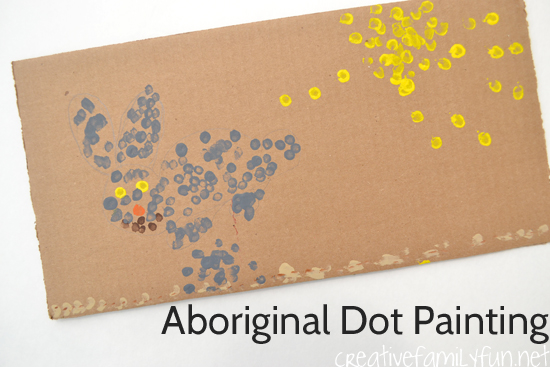
We used a cut apart cardboard box for our painting surface. You can actually do this project on paper, I was just looking for something a little more solid and I wanted the brown background. Use whatever you have on hand for your project.
Before we got started painting, I had the girls draw simple outlines of their subjects. Despite their complete infatuation of all things Australia, the girls didn’t want to draw any of the Australian animals. One drew a rabbit and the other a bathing suit (she’s really into fashion design). After we had simple pencil outlines, the girls used their cotton swabs to fill in their designs with dots.
In order to stay true to traditional dot art, we chose colors that were earth tones, or other colors found in nature. The brightest color we chose was yellow. Even though the girls chose non-traditional subjects, the art technique and colors reminded us of all the examples of traditional Aboriginal dot art that we saw. It was such a fun painting technique and one I hope we revisit some day.
Thank you for travelling along on our virtual trip around the world. To see all the projects we’ve done so far, please click here or on the image below.
 

Illuminated Manuscript Initials: Exploring Armenia Through Art

June 16, 2015 By Terri Thompson

There’s an area of land sandwiched in between the continents of Asia and Europe, called Eurasia. Armenia is a small, mountainous country located in that area. It is in Asia, very near Europe. (See it on a map here.) Armenia was a part of the former Soviet Union after being taken over by Russia following World War I. The modern Republic of Armenia gained its independence in 1991.


For our artistic inspiration, we went far back in history, way before World War I. Every time I went searching for Armenian art, I discovered illuminated manuscripts. While not exclusive to Armenia, I found many wonderful Armenian examples. Here is an illustrated version of the Armenian alphabet done in the style of illuminated manuscripts. The Armenian alphabet is also unique with a rich history. It was created in 405 A.D. You can read about the history here. The written word and beautifully illustrated versions are an important part of Armenia’s history. We used this inspiration to create illustrated versions of our initials.
Disclosure: This post contains Amazon Affiliate links. Please see my disclosure for more details.
We started by cutting out our initials from wrapping paper. We were looking for something fancy and shiny. We settled on the silver wrapping paper we found in our closet. After cutting out the initials, we glued them down to plain white paper. If you don’t have fancy wrapping paper, you could also use scrapbook paper, construction paper, or magazine pages. I wouldn’t recommend aluminum foil as it won’t glue down to the white paper.
We used our collection of Sharpies to decorate our initials. I wasn’t sure if the washable markers would work on the shiny wrapping paper, so we went with the permanent markers. They worked perfectly! The girls decorated their initials and they decorated the paper surrounding the initials, just like some of the pictures we viewed. After we were done, we got more paper and made more initials. It was fun to see how fancy we could make them!


It has been such a valuable experience to explore the world through art. The girls missed it while we took a short break for the busy, busy month of May. We’re eager to start exploring again!

Thanks for coming along on our virtual trip to Armenia with Project: Around the World. Click here for all the projects we’ve done so far or on the button below.
 

Handprint Art: Exploring Argentina Through Art

April 29, 2015 By Terri Thompson

What happens when we can’t decide between two different art projects in Project: Around the World? Well… we end up doing two. We started with our Colorful Building Paper Collages and I thought that would be it. But, I just couldn’t get the idea of handprint art out of my system. More specifically, I kept thinking about the hand outlines at Cueva de las Manos in Argentina. (You can see them here.) This amazing cave art is between 9500 and 13,000 years old. Wow! I just knew we could make our own version at home.
Disclosure: This post contains Amazon Affiliate links. Please see my disclosure for more details.


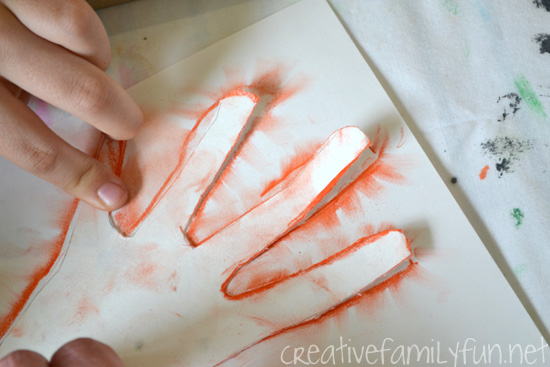
The first step in our process was to make our stencils. We used paper plates since they are thicker and sturdier than regular paper. The girls each traced a hand on a plate and cut out the handprint. They decided to trace part of their arm too so that it looked more like the cave paintings.
I had some legal size paper (8.5″ x 14″), so we traced our handprints on that. Letter size paper would work too. The girls used their stencils and traced around it with a chalk pastel. We used different shades of grays and browns to mimic the cave art.
After tracing the stencil, we left it in place and used our fingers to gently swipe outward from the stencil. You will get a fun feathery effect which looks a lot like the handprints at Cueva de las Manos. We repeated the process until we had filled our paper with handprints.
The result was awesome! And, as you can see we didn’t stick with our brown color scheme. Why use brown when you can use blue? Let your kids take the reign any time they want during art projects. They can come up with amazing ideas. Plus, it becomes their project and not just a parent-directed project. (And, quite frankly, a parent-controlled project isn’t all that fun.)
Thanks for coming along on Project: Around the World. Click here for all the projects or on the button below.
 

  • « Go to Previous Page
  • Page 1
  • Page 2
  • Page 3
  • Page 4
  • Page 5
  • Interim pages omitted …
  • Page 11
  • Go to Next Page »

Primary Sidebar

Footer

Categories

Archives

Copyright © 2026 · Designed by The Blog Surgery

Creative Family Fun uses cookies to improve your experience. These cookies provide feedback to our analytics and advertisers. We use the information to track views of the site, where you go and to know if you are a regular visitor or brand new as well as provide a personalized experience where possible. We'll assume you're ok with this, but you can opt-out if you wish.Accept Reject Read More
Privacy & Cookies Policy

Privacy Overview

This website uses cookies to improve your experience while you navigate through the website. Out of these, the cookies that are categorized as necessary are stored on your browser as they are essential for the working of basic functionalities of the website. We also use third-party cookies that help us analyze and understand how you use this website. These cookies will be stored in your browser only with your consent. You also have the option to opt-out of these cookies. But opting out of some of these cookies may affect your browsing experience.
Necessary
Always Enabled
Necessary cookies are absolutely essential for the website to function properly. This category only includes cookies that ensures basic functionalities and security features of the website. These cookies do not store any personal information.
Non-necessary
Any cookies that may not be particularly necessary for the website to function and is used specifically to collect user personal data via analytics, ads, other embedded contents are termed as non-necessary cookies. It is mandatory to procure user consent prior to running these cookies on your website.
SAVE & ACCEPT