• Skip to secondary menu
  • Skip to main content
  • Skip to primary sidebar
  • Skip to footer
  • Home
  • About
    • Email Me
    • Disclosure & Copyright
  • Start Here
  • Subscribe
  • Privacy Policy
  • Books for Moms

Creative Family Fun

Your one-stop shop for kids activities and family fun

  • Facebook
  • Instagram
  • Pinterest
  • Twitter
  • Spelling Activities
  • Family Fun
  • STEM
  • Movie Night
  • Toddler Activities

Math Activities for Kids

Backyard Measurement Scavenger Hunt

July 4, 2017 By Terri Thompson

I’m always trying to come up with ways to take learning outside.

Now, I’m not talking about taking a workbook outside to do instead of working at the kitchen table. I’m talking about using nature as a tool to help with learning.

And, that’s why I love this backyard measurement scavenger hunt.  It’s the perfect combination of math and outdoor learning.
Take your learning outside with this fun backyard measurement scavenger hunt. Grab your printable scavenger hunt and get ready to learn math outside.

Disclosure: This post contains Amazon Affiliate and other affiliate links. Please see my Disclosure Page for more details.

Grab your supplies

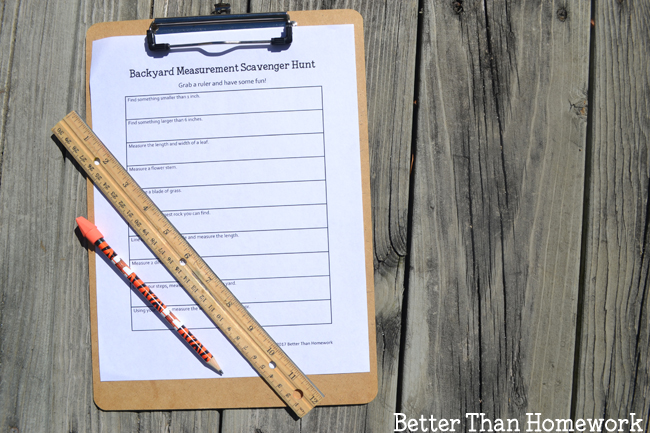
You’ll need a ruler, pencil, clipboard (or other hard surface), your printable scavenger hunt sheet, and a couple of willing participants. That’s all it take to prep this activity.

This scavenger hunt is designed to be done in just about any yard. You should be able to find everything whether you live in the city or country.
Take your learning outside with this fun backyard measurement scavenger hunt. Grab your printable scavenger hunt and get ready to learn math outside.

It’s time to go on our backyard measurement scavenger hunt!

Make sure you have your ruler and head outside.

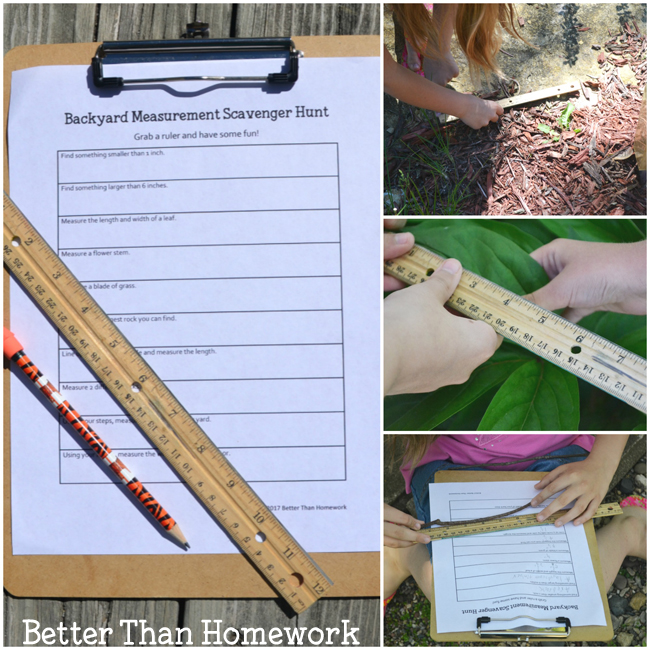
Can you find something smaller than one inch? Or something larger than six inches? We found a small rock and a length of landscape timber.

Can you line four rocks up side by side and measure them? Ours totaled one and a half feet.
Take your learning outside with this fun backyard measurement scavenger hunt. Grab your printable scavenger hunt and get ready to learn math outside.

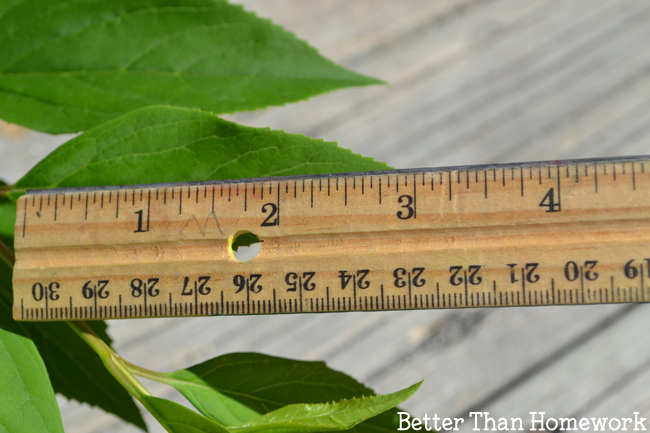
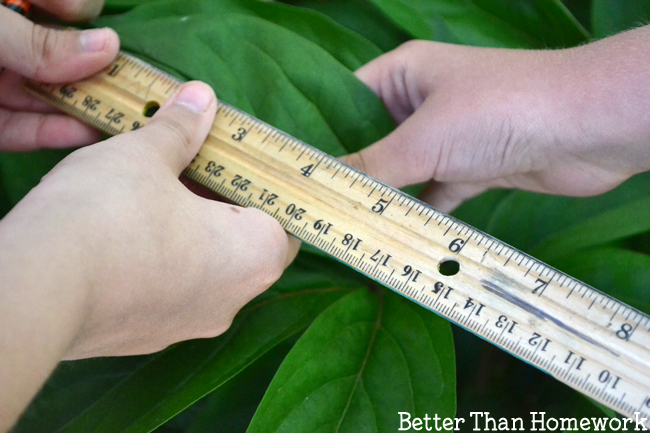
Try measuring the length and width of a leaf. We found a big one that was five and a half inches long and two and a half inches wide.

You won’t need a ruler for everything.

Now it’s time to put the ruler away and try a little measuring with nonstandard units.

We’re going to measure with our hands and our feet.

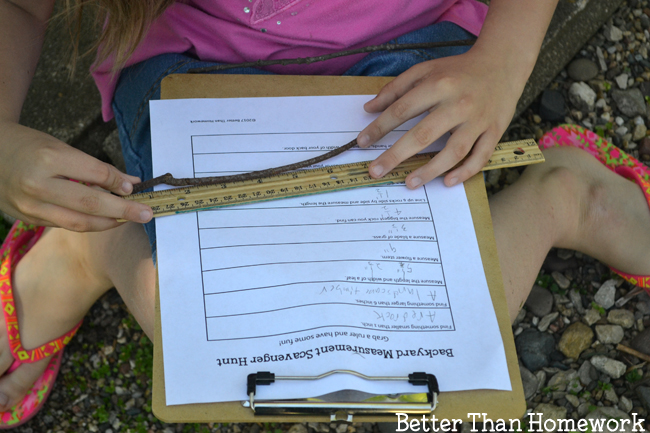
Use your feet to measure the width of your yard and use your hands to measure the width of your back door. What number did you get?
Take your learning outside with this fun backyard measurement scavenger hunt. Grab your printable scavenger hunt and get ready to learn math outside.

It’s fun to do math outside

This backyard measurement scavenger hunt is a great outdoor math activity. You’ll learn about measurement and work on math skills all while getting out and exploring your own backyard.

It’s so much fun to use nature to do math!

Don’t forget to grab your scavenger hunt printable here.
Take your learning outside with this fun backyard measurement scavenger hunt. Grab your printable scavenger hunt and get ready to learn math outside.

If you enjoyed this outdoor math game, you can share the above photo on Facebook or you can save the photo below on Pinterest

Take your learning outside with this fun backyard measurement scavenger hunt. Grab your printable scavenger hunt and get ready to learn math outside.

You may also enjoy one of these math activities:

Build Numbers With a Fun Place Value Activity

Subtraction with Loose Parts Math Activity

Sidewalk Chalk Outdoor Math Game at Creative Family Fun

Hopping Bunnies Measurement Activity at Inspiration Laboratories

Math Art: Skip Counting Pointillism

June 19, 2017 By Terri Thompson

I’m very fascinated with the combination of math and art. There are some truly amazing things you can do. And honestly, the ideas are endless.

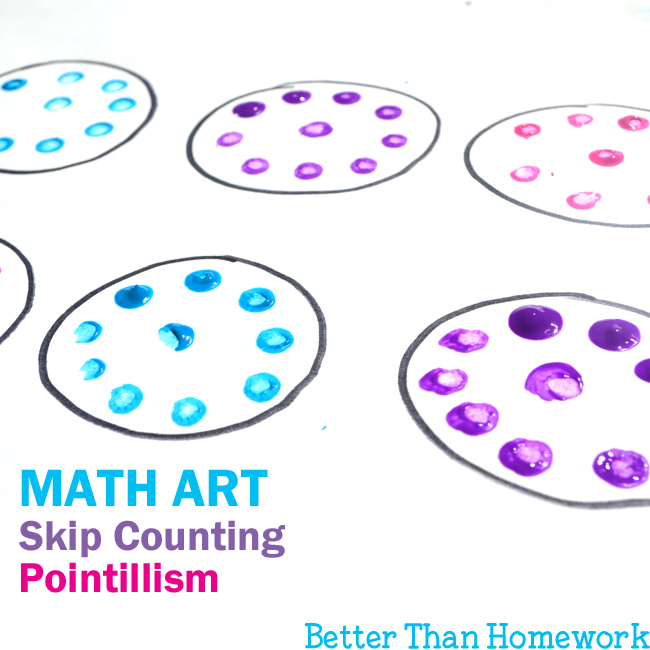
This time we kept it simple with a math art project that combined pointillism and skip counting. It was simple and the results were fun.

Add some creativity to your math practice with this fun math art project for kids. Learn about pointillism and do practice skip counting at the same time.

Disclosure: This post contains Amazon Affiliate and other Affiliate links. Please see my Disclosure Page for more details.

What is pointillism?

Before we begin, we need to understand our art term, pointillism. To create pointillism, a painter uses small, distinct dots in varying colors applied in a pattern to form an image.

One of the most famous paintings that uses this technique is A Sunday on La Grande Jatte by Georges Seurat. You can see it here.

So, for the art portion of our project, we’ll be using dots to create our pictures.

What is skip counting?

Skip counting is basically counting by any number other than one. You can count by 2s: 2, 4, 6, 8, 10. Or, you can count by 5s: 5, 10, 15, 20, 25.

You can find a detailed explanation of skip counting here at Creative Family Fun.

We’ll be counting by 10s for this project.

Add some creativity to your math practice with this fun math art project for kids. Learn about pointillism and do practice skip counting at the same time.

Now let’s combine pointillism and skip counting for a fun math art project.

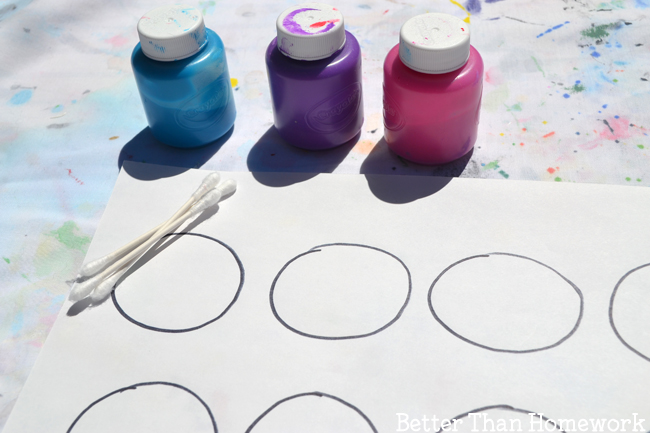
First, you’ll need a few supplies: paint, cotton swabs, marker, and paper.

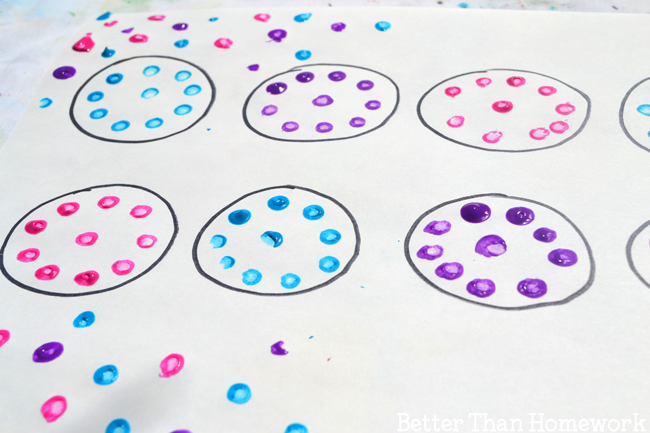
Next, you’ll need to lay your foundation. We were skip counting by 10 all the way to 100 so I drew ten simple circles on my paper for each of my set of dots.

Don’t limit yourself to circles. You can do triangles, squares, ovals, or any fun design of your choice. You just need one shape for each set of ten.

Add some creativity to your math practice with this fun math art project for kids. Learn about pointillism and do practice skip counting at the same time.

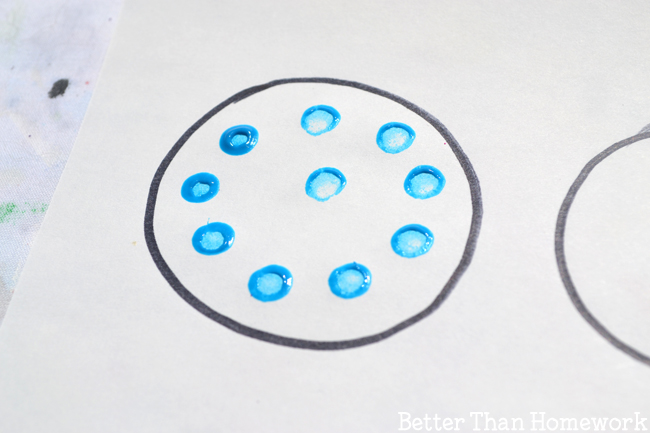
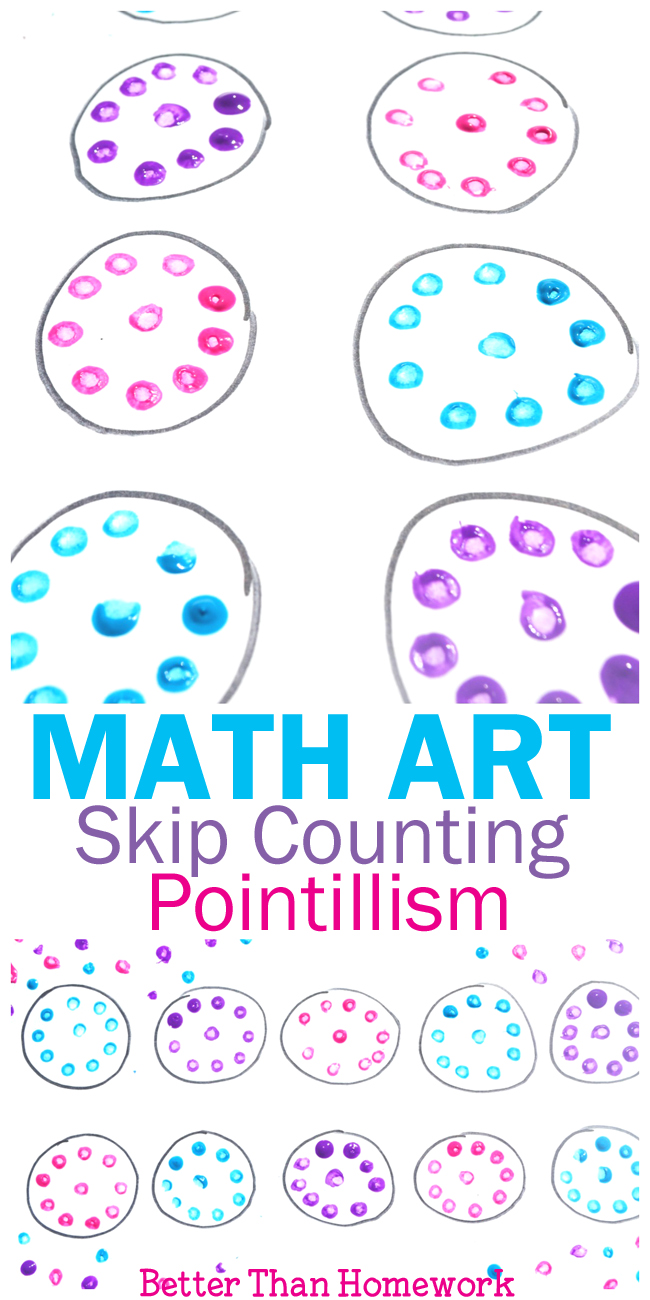
Once you’ve got your foundation, it’s time to paint. Dip your cotton swabs in paint and use them to create a design of dots in each circle. Put ten dots inside each circle.

Use a simple design or just random dots. The important part of the project is to make sure you only have 10 dots in each shape.

Add some creativity to your math practice with this fun math art project for kids. Learn about pointillism and do practice skip counting at the same time.

Now it’s time to skip count!

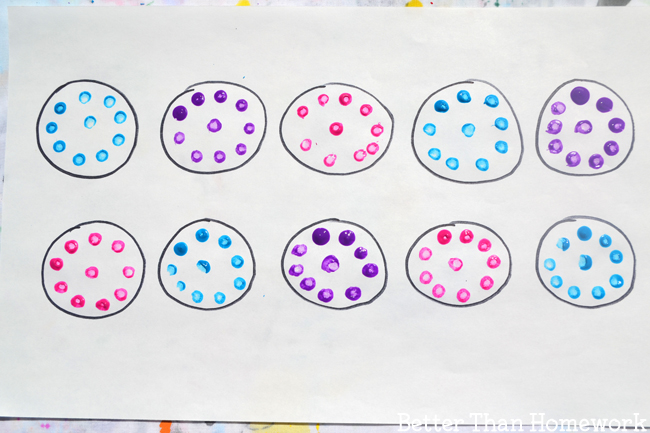
Once you have your dots in each circles, you’ve got a pretty representation of skip counting by ten.

Count your circles: 10, 20, 30, 40, 50, 60, 70, 80, 90, 100. You’ve got one hundred dots total on your skip counting math art project!

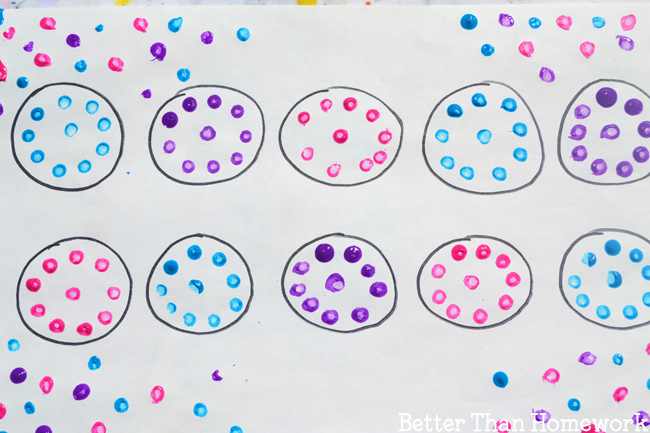
When you’re done, feel free to be creative and add even more dots to make an art project you’re proud of. Our skip counting is inside our shapes and the embellishment is just for fun.

Add some creativity to your math practice with this fun math art project for kids. Learn about pointillism and do practice skip counting at the same time.

More versions of this math art project:

Paint a picture for each set of skip counting numbers. What shapes will you use when you’re counting by twos? What shapes for counting by fives? Can you make a unique painting for each skip counting set?

Can you create skip counting sets without drawing the foundation shapes? Use just your dots to create ten different design sets.

Use this project to illustrate a multiplication problem. Do a math pointillism project for 5×5, 6×9, or 8×4. Fun, right?

How else can you do math pointillism?

How would you mix this project up?

Add some creativity to your math practice with this fun math art project for kids. Learn about pointillism and do practice skip counting at the same time.

If you enjoyed this math art project, the above picture is perfect for sharing on Facebook, or you can share the picture below on Pinterest.

Add some creativity to your math practice with this fun math art project for kids. Learn about pointillism and do practice skip counting at the same time.

You may also like one of these math activities:

Fine Motor Skip Counting Activity

Making Ten With Cars

Skip Counting by Tens with Bottle Caps at Creative Family Fun

Potato Printing Tesselations at Rainy Day Mum


Sidewalk Chalk Outdoor Clock Game

June 7, 2017 By Terri Thompson

I never did discover just how much fun math can be until I had kids of my own. It’s not just a pile of worksheets after all!

I try to support my girls’ math learning at home all the time. And, when it comes to math practice at home, I’ve got one criteria – it has to be fun!

So we grabbed out sidewalk chalk and went outside to practice math with a fun outdoor clock game.

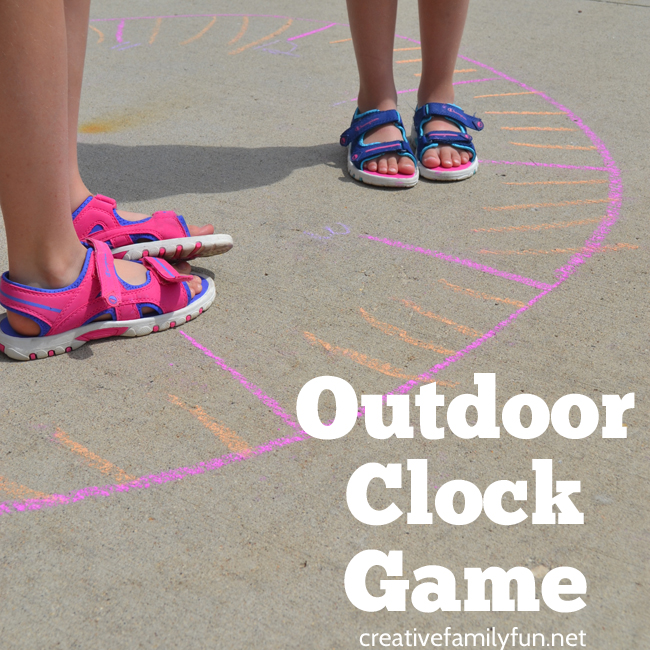
This outdoor clock game is a fun way to get outside, get moving, and practice telling time with a giant sidewalk chalk clock.

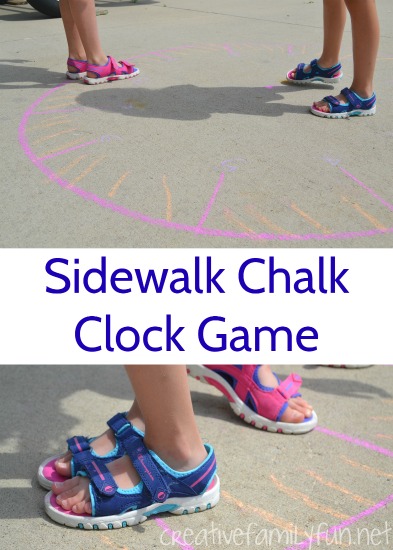
This Sidewalk Chalk Clock Game is a fun way to get outside, get moving, and practice math. Can math practice be anymore fun?

Disclosure: There are Amazon Affiliate and other affiliate links in this article which means, at no additional cost to you, we could receive compensation for our recommendations. You can read our full disclosure policy on our Disclosure Page for more details.

This outdoor clock game is a fun way to get outside, get moving, and practice telling time with a giant sidewalk chalk clock.

Set up your outdoor clock game

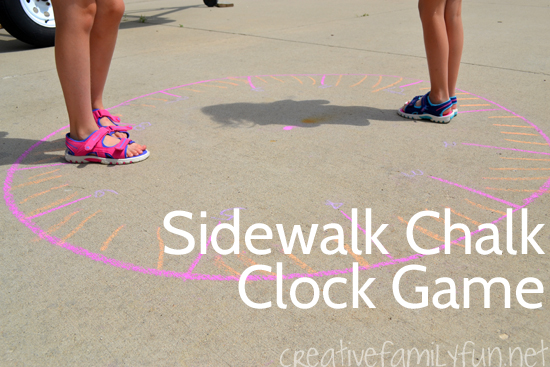
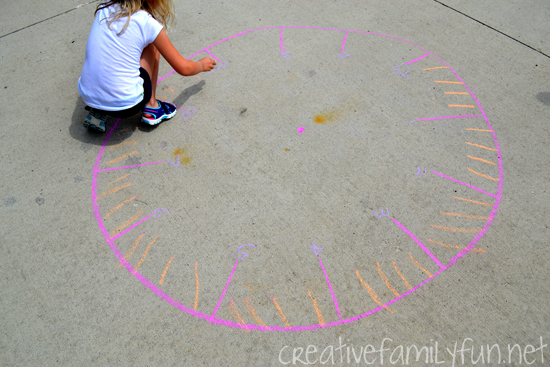
Before we began the game, we drew a big clock on our driveway with sidewalk chalk.

Your kids will need to move around the clock and use their bodies as the clock hands, so you need to make a large clock.

I drew the circle and the marks for each hour. I had the girls fill in the numbers for the hours and the extra lines in between each. It truly was a collaborative effort.

This outdoor clock game is a fun way to get outside, get moving, and practice telling time with a giant sidewalk chalk clock.

How to play this clock game

The game works best with two people. One person is the hour hand and the other person is the minute hand.

Since my girls are at two different levels in math, I had my youngest daughter (1st grade) be the hour hand and my older daughter (3rd grade) be the minute hand.

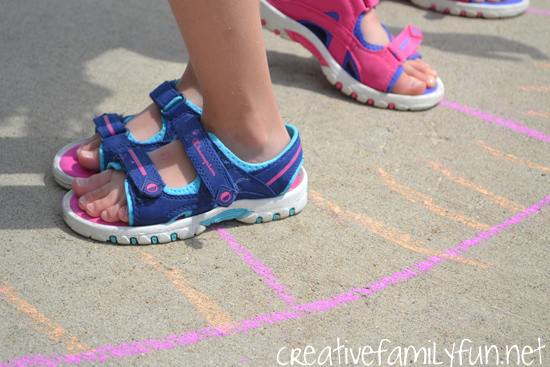
Once we were ready, I called out a time. The girls had to stand on the correct location.

For instance, If I said “1:30,” one child would stand on the 1 and the other child would stand on the 6. In order to challenge my oldest, I would call out harder times like 3:56, 5:18, and 12:23. Keep with whatever level your child is at.

Easy game variation for one child

If you are playing with only one child, get in and play the game with them!

Or, use rocks for one or both of the hands. One rock for the hour hand and one rock for the minute hand. Instead of standing in the correct locations, place the rocks in the correct location.

This outdoor clock game is a fun way to get outside, get moving, and practice telling time with a giant sidewalk chalk clock.

This outdoor clock game is tons of fun and can be easily adapted for any level.

My girls always love to take their learning outside – and who can blame them?

Draw a clock on the driveway and you’ll have tons of learning fun, at least until the next time it rains!

This outdoor clock game is a fun way to get outside, get moving, and practice telling time with a giant sidewalk chalk clock.

 You may also like one of these math games:

Practicing Counting On in Nature

Rock Sums

Number Stories at the Park

Fine Motor Skip Counting Activity at Better Than Homework

Clock Playdough Mats at This Reading Mama

Counting On Card Game

May 11, 2017 By Terri Thompson

Did you know that you already have two of my favorite tools for math practice in your home?

I promise you do. Just head to your game closet and you’ll find it.

What am I talking about? A deck of cards and a pair of dice. That’s it!

Keep them available during the school year, and you and the kids will have tons of fun practicing math such as this counting on card game to help practice this math skill.

Grab a deck of cards and some dice to play this simple counting on card game. It's an easy way to practice math after school.

In Counting On: The Card Game, we’re practicing the basic skill of counting on (counting beginning at any number other than one).

This game is easy to learn and a cinch to pull together after school. Come on, let’s have fun practicing math.

Disclosure: There are Amazon Affiliate and other affiliate links in this article which means, at no additional cost to you, we could receive compensation for our recommendations. You can read our full disclosure policy on our Disclosure Page for more details.

Grab a deck of cards and some dice to play this simple counting on card game. It's an easy way to practice math after school.

Supplies Needed:

Deck of cards with the Jacks, Queens, Kings, and Jokers removed

Dice (1 or 2)

Or add some movement to this fun game with a giant deck of cards and large dice!

Instructions for this Counting On card game:

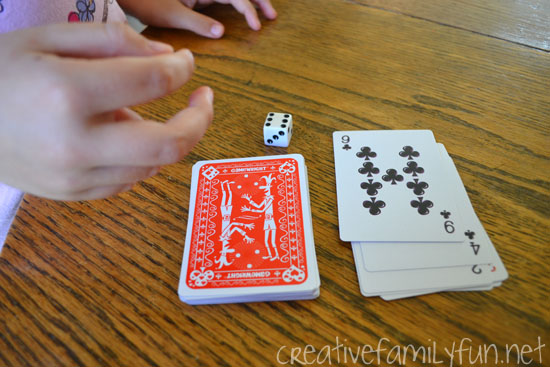
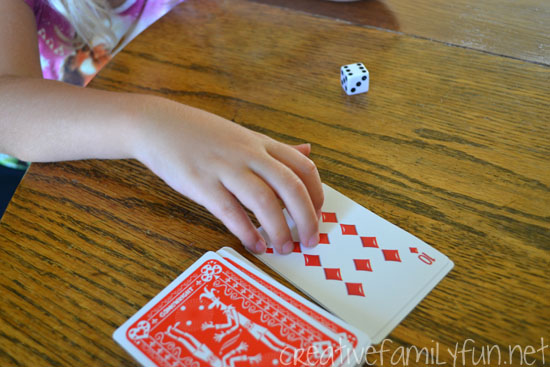
Shuffle and place the cards face down on the table. Player one flips over the top card and starts a discard pile.

Next the first player will throw the dice. Their challenge is to start counting from the number shown on the card and count on the number of times shown on the dice.

Take turns flipping over a card and counting.

There is no winner or loser in this game. It’s just simply a turn-taking game.

Grab a deck of cards and some dice to play this simple counting on card game. It's an easy way to practice math after school.

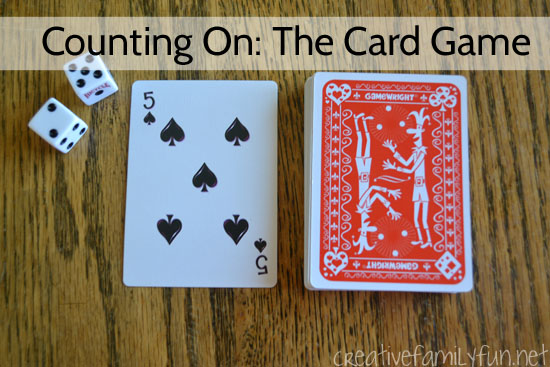
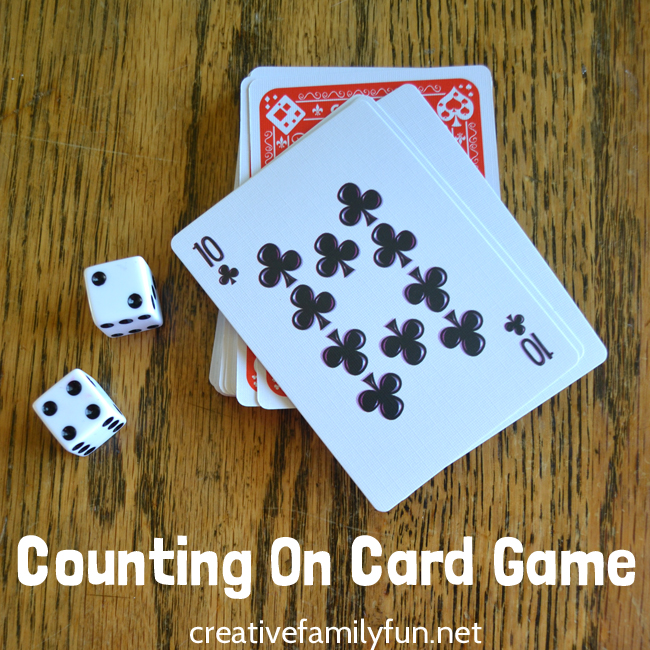
The game is quite simple and won’t take long to learn. In the picture above, my daughter turned over a 10. She then threw a dice and got a 6. She started at 10 and counted: 10, 11, 12, 13, 14, 15, 16.

To make it more difficult, my oldest daughter skipped the counting on and just added the number on the card to the number on the dice in her head. This is a great way to play the game with kids at different skill levels.

What are you waiting for? Let’s go have some fun with math while we play this counting on card game!

Grab a deck of cards and some dice to play this simple counting on card game. It's an easy way to practice math after school.

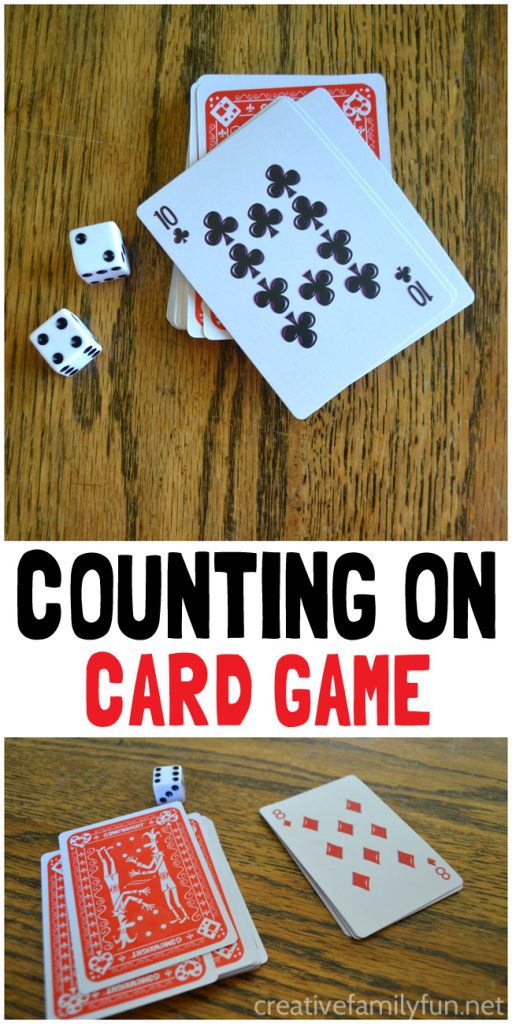
If you enjoyed this counting on card game, the photo above is perfect for sharing on Facebook or you can share the photo below on Pinterest.

Grab a deck of cards and some dice to play this simple counting on card game. It's an easy way to practice math after school.

You may also like one of these fun learning ideas:

Practicing Counting On in Nature

Pick Two: A Fun LEGO Math Game

Hot Chocolate Science

31 Ways to Practice Spelling Words

Exploring Greater Than and Less Than with Playing Cards at Better Than Homework

Are you looking for more activities?

Join our fun Facebook community, Creative Family Fun for Busy Families, for daily activities that are great for kids and families. We’ll chat, share, and have fun. It’s a safe and private place to share idea for family and kids activities.

I’d love for you to join me! Just click the link below, request to join, and answer the questions (they’re easy, I promise). Come join the fun! Join the Creative Family Fun for Busy Families community here.

Build Numbers with a Fun Place Value Activity

May 8, 2017 By Terri Thompson

,Math is a series of building blocks. Each piece builds upon the the previous piece. That’s why it’s so important to understand one piece before moving on to the next piece.

Place value is one of those important pieces. It’s crucial to understand all the different parts of each number.

This place value activity is a fun hands-on and visual way for kids to learn and practice value. Understanding will soon become second nature as they build each number.

Use index cards to create a fun place value activity for elementary kids. They'll build numbers while learning all about the place value of each number.

Disclosure: There are Amazon Affiliate and other affiliate links in this article which means, at no additional cost to you, we could receive compensation for our recommendations. You can read our full disclosure policy on our Disclosure Page for more details.

Set up your place value activity

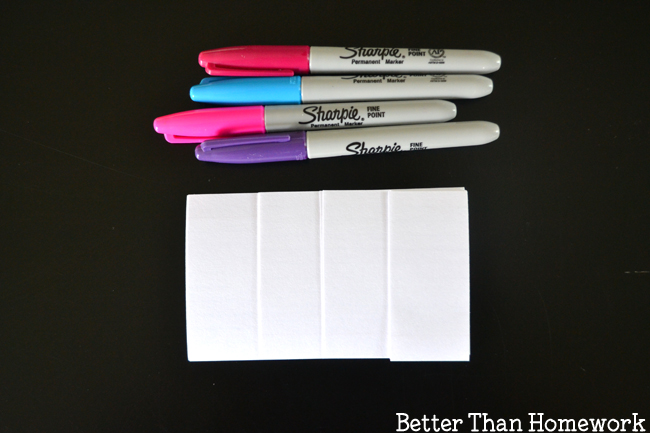
You’ll only need a few supplies for this activity: a pack of index cards, a few markers, and scissors.

Decide how many numbers you want to make. If you make the numbers 1-9 for each place value, your kids will be able to make every number from 1 through 9999.

To make all the numbers, leave nine index cards whole. Cut some in half, so that you have 9 half pieces. You’ll also want 9 pieces that are 3/4 sized and 9 pieces that are 1/4 size.

Use index cards to create a fun place value activity for elementary kids. They'll build numbers while learning all about the place value of each number.

Write your numbers on your index cards. Make sure you write the numbers big enough so that each digit can be covered by 1/4 of the index cards.

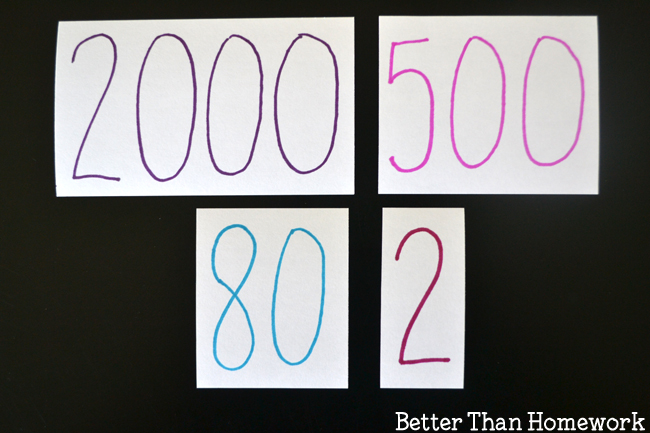
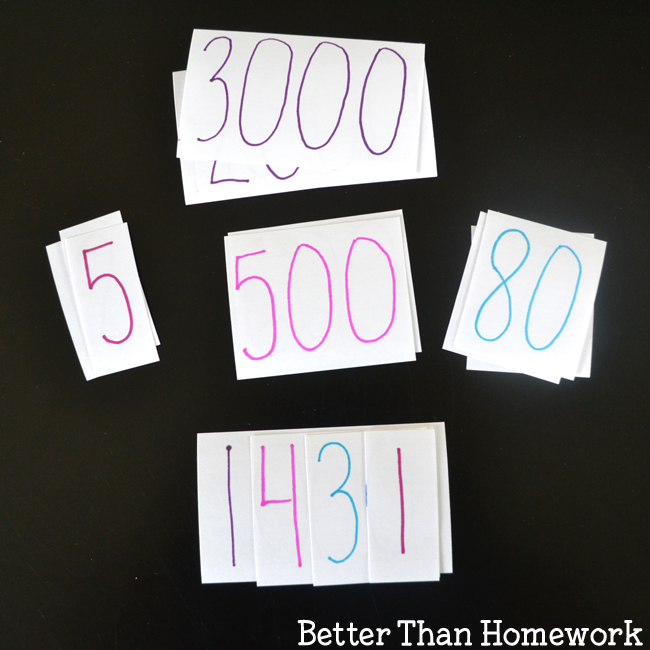
The whole cards will be for your thousands. Write the number 1000, 2000, 3000, through 9000 on the cards.

On your 3/4-sized cards, write your hundreds from 100 – 900.

Your 1/2-sized cards are for your tens and your 1/4-sized cards are for your ones.

Use index cards to create a fun place value activity for elementary kids. They'll build numbers while learning all about the place value of each number.

Build your numbers

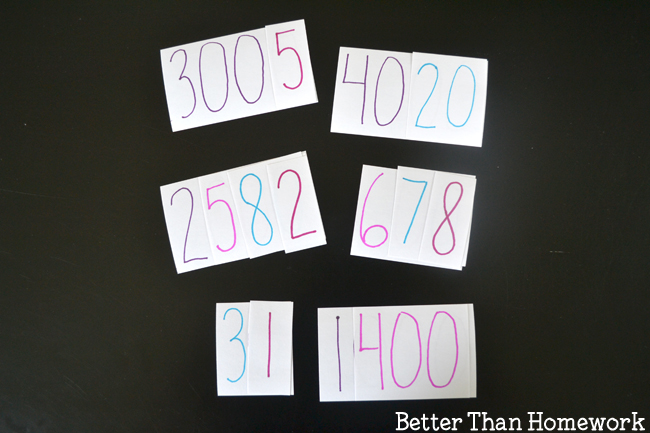
Use your place value index cards to build new numbers.

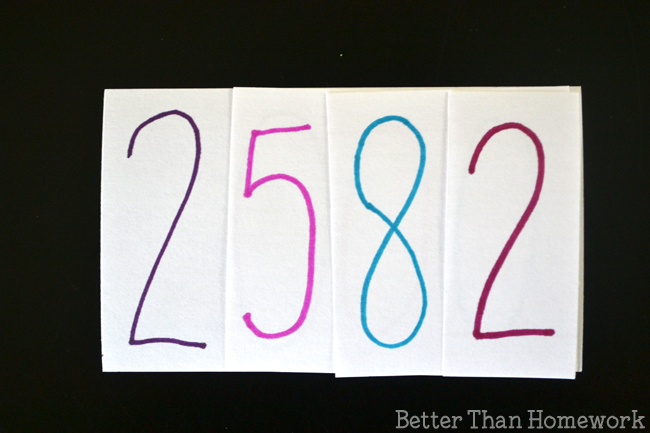
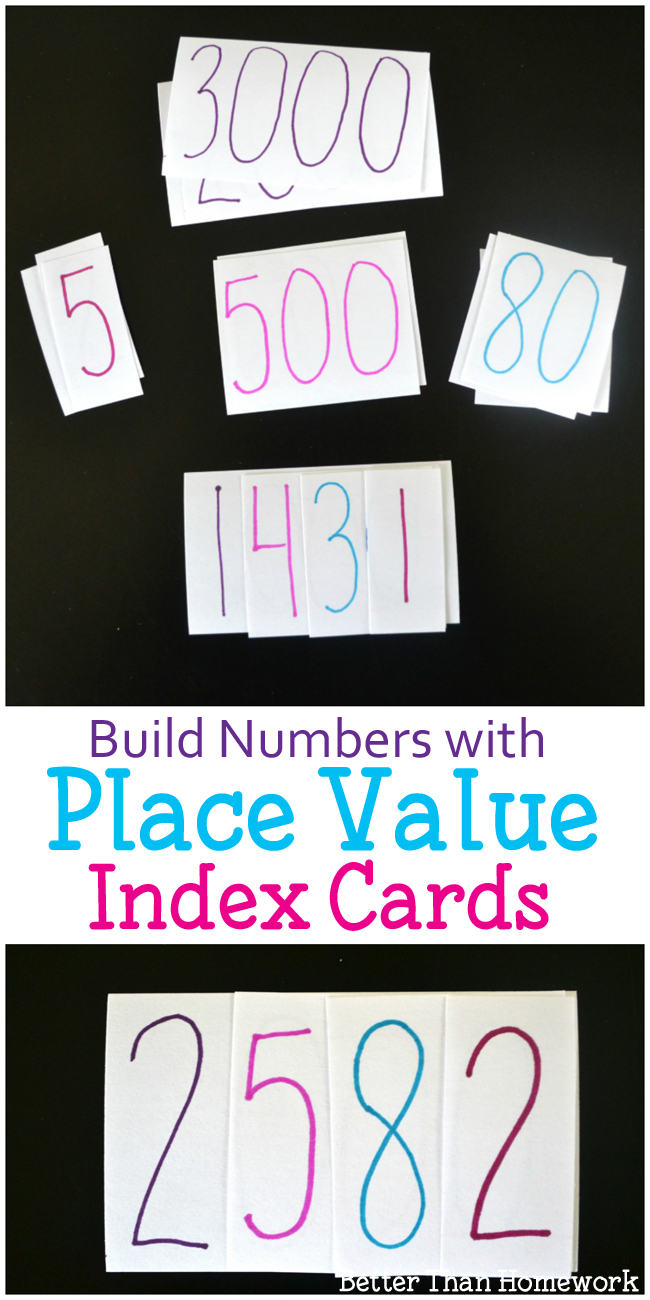
Start with a base of one of your thousands cards. Add a hundreds card, next a tens card, and then finally a ones card. Step by step, your child will be able to see how each number fits with place value.

When you take the numbers apart, you can lay them out next to each other to see how the number is built by place value, 2000 plus 500 plus 80 plus 2 equals 2582.

The number possibilities are endless!

Use index cards to create a fun place value activity for elementary kids. They'll build numbers while learning all about the place value of each number.

More ways to play and learn with your Place Value Index Cards

*Add extra elements to increase the learning. Build the number. Say the number. Write the number.

*Say a number out loud and then have your child build that number.

*Build four or five different numbers and put them in order from smallest number to largest number.

Use index cards to create a fun place value activity for elementary kids. They'll build numbers while learning all about the place value of each number.

If you enjoyed this place value activity, the above photo is perfect for sharing on Facebook or you can Pin the photo below on Pinterest.

Use index cards to create a fun place value activity for elementary kids. They'll build numbers while learning all about the place value of each number.

You may also like one of these math activities:

Hands-On Perimeter Lab

Math Paper Plate Games

Domino Addition

Math Fact Sticks at Creative Family Fun

Learn Place Value with Building Blocks at Teach Me Mommy


  • « Go to Previous Page
  • Page 1
  • Interim pages omitted …
  • Page 7
  • Page 8
  • Page 9
  • Page 10
  • Page 11
  • Interim pages omitted …
  • Page 17
  • Go to Next Page »

Primary Sidebar

Footer

Categories

Archives

Copyright © 2026 · Designed by The Blog Surgery

Creative Family Fun uses cookies to improve your experience. These cookies provide feedback to our analytics and advertisers. We use the information to track views of the site, where you go and to know if you are a regular visitor or brand new as well as provide a personalized experience where possible. We'll assume you're ok with this, but you can opt-out if you wish.Accept Reject Read More
Privacy & Cookies Policy

Privacy Overview

This website uses cookies to improve your experience while you navigate through the website. Out of these, the cookies that are categorized as necessary are stored on your browser as they are essential for the working of basic functionalities of the website. We also use third-party cookies that help us analyze and understand how you use this website. These cookies will be stored in your browser only with your consent. You also have the option to opt-out of these cookies. But opting out of some of these cookies may affect your browsing experience.
Necessary
Always Enabled
Necessary cookies are absolutely essential for the website to function properly. This category only includes cookies that ensures basic functionalities and security features of the website. These cookies do not store any personal information.
Non-necessary
Any cookies that may not be particularly necessary for the website to function and is used specifically to collect user personal data via analytics, ads, other embedded contents are termed as non-necessary cookies. It is mandatory to procure user consent prior to running these cookies on your website.
SAVE & ACCEPT