• Skip to secondary menu
  • Skip to main content
  • Skip to primary sidebar
  • Skip to footer
  • Home
  • About
    • Email Me
    • Disclosure & Copyright
  • Start Here
  • Subscribe
  • Privacy Policy
  • Books for Moms

Creative Family Fun

Your one-stop shop for kids activities and family fun

  • Facebook
  • Instagram
  • Pinterest
  • Twitter
  • Spelling Activities
  • Family Fun
  • STEM
  • Movie Night
  • Toddler Activities

Learning Activities for Kids

10 Ways to Learn About Birds

March 22, 2012 By Terri Thompson

We’ve been enjoying our time learning about birds this week.

Birds are all around and fun to learn about.

They’re fascinating and so different from me or you, or even the family dog.

If your kids are interested in birds, I’ve compiled 10 fun ways to help your kids learn about birds.

Disclosure: There are Amazon Affiliate and other affiliate links in this article which means, at no additional cost to you, we could receive compensation for our recommendations. You can read our full disclosure policy on our Disclosure Page for more details.

1. Observe birds. We are fortunate to have been able to visit the National Eagle Center and observe eagles up close. Through observation, we’ve learned size, color, sound and the impressive wing span of an eagle. Unfortunately, it’s not always practical to be able to observe birds at a location devoted to them. Luckily, birds are everywhere! Take a trip to a local lake, river, or hiking trail. Or, even better, just walk out into your own backyard. Having Fun at Home shares a creative way to observe and keep track of the birds that visit their backyard.

2. Listen to birds. While you’re observing, use your ears. What do birds sound like? Can you identify a bird by it’s call? ENature.com has an amazing collection of bird calls that you can listen to for free. Listen to all the different calls. Amazing, isn’t it?

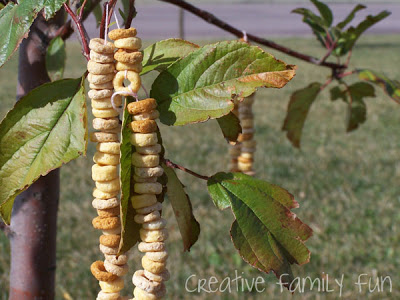
3. Feed the birds. Learn about the different food that birds eat and create a bird-friendly yard. We made Cheerio bird feeders and Glittering Muffins made simple bird feeders out of cardboard tubes. You could also make some fun Cookie Cutter bird feeders like these from Kitchen Counter Chronicles.
4. Read a book about birds. There are many books written for kids about birds. You should be able to find one at any age level. We’ve enjoyed A Nest Full of Eggs (Let’s-Read-and-Find-Out Science, Stage 1) by Priscilla Belz Jenkins, The Bird Alphabet Book by Jerry Pallotta, and About Birds: A Guide for Children by Cathryn Sill. Your local library is sure to have a collection of bird books for children.

5. Learn about nests. We were recently able to study a real bird’s nest. But, if you don’t have one, you can make your own! Sun Hats and Wellie Boots made nests from mud and twigs. Mommy & Me Book Club made large nests from branches and twigs. Get hands on and learn how a nest is put together.

6. Help a bird build a nest. While you won’t actually be able to work side-by-side with a bird, you can provide them with materials to help build their nests. Paint Cut Paste shows you how to make fun nest zests and Inner Child Fun shows you how to make colorful bird nesters. Learn about the materials used to build a nest and help the birds at the same time.

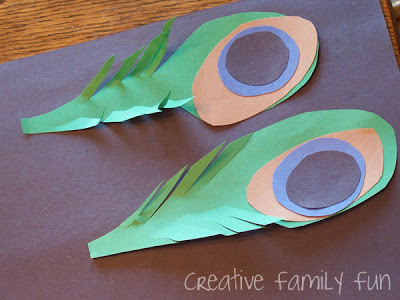
7. Learn about feathers. If you can, find a feather to examine. Feel how light it is. Fun your fingers along the side and feel the texture. Have some fun with the feathers and paint with them like this example from Mommy and Me Book Club. You can also try your hand at creating feathers, like we did with these peacock feathers or our feather stencils.
8. Learn to identify birds. What characteristics do you need to observe in order to determine the type of bird. Find a good bird book and learn about all the different types of birds that live around you. Inner Child Fun created this simple backyard field guide for an inexpensive, child-friendly option.

9. Get active! Learn about birds through active play. Flap your arms like a bird. Can you feel the breeze it makes? Pretend to glide through the air or land on a branch. Help your kids learn about birds and burn off some energy at the same time.

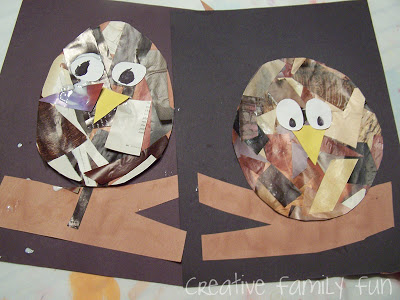
10. Do a bird craft. Do a quick search for birds on Pinterest and you’re sure to find many ideas. We made these cute collage owls. Toddler Approved made cute chicks using tape. Dilly-Dali Art made fun light bulb birds. Creativity My Passion made colorful birds from recycled tissue boxes. And this is just the tip of the iceberg or fun bird crafts! (Again, you can check my Birds Pinterest Board for more fun bird crafts.)
*Bonus Activity: You’re never to young to learn about birds! The Educators’ Spin On It shares some wonderful ways to introduce babies to the natural world and the wonders of birds.

What is your favorite way to learn about birds?

Exploring Nature: Bird’s Nest

March 20, 2012 By Terri Thompson

This past fall, we discovered a bird had built a nest in our garage on top of the garage door opener.It had been abandoned at some point (probably when the poor birds realized just how loud a garage door can be).

We pulled it down, showed the girls, then it was placed in a plastic bin and forgotten about.

When Lizzie requested that we spend this week learning about birds, I happened to spot the nest again.

Perfect! I got out the nest, took it outside, and we started exploring.

Disclosure: There are Amazon Affiliate and other affiliate links in this article which means, at no additional cost to you, we could receive compensation for our recommendations. You can read our full disclosure policy on our Disclosure Page for more details.

We found the perfect book at the library to help us learn about this nest of ours, A Nest Full of Eggs by Priscilla Belz Jenkins. The book was written for young children and my preschool-aged child easily understood and enjoyed this book.

We learned about how birds make nests, lay their eggs, how birds grow from egg to adult, and the different kinds of nests birds build.

While we were reading, we examined the nest.

We looked closely to see what materials the bird used to build this nest and came to the conclusion that the bird must have gathered a lot of materials for a nearby farm.

We each held on to a side and tried tugging. We learned how strong a bird’s nest is since it didn’t come apart at all.

We felt inside and discovered how soft it is. We decided it would be a very comfortable spot for an egg to rest. I know that my girls learned a lot through our bird’s nest exploration.

We had fun, asked questions, drew our own conclusions, and now how more knowledge of the natural world we live in.

Will It Float? Making Boats

March 13, 2012 By Terri Thompson

Yesterday, Lizzie looked up at me and said, “Mom, I want to make a speed boat. One with a window on the front.”

Well, okay… let’s get started!

Keep in mind that unlike most of my other projects, this time I had no plan whatsoever going into this. We were winging it, but we were up to the challenge.We dug through our recycled parts and came up with an empty toilet paper tube. Was it lightweight? Check. Will it float? I hope so.

Disclosure: There are Amazon Affiliate and other affiliate links in this article which means, at no additional cost to you, we could receive compensation for our recommendations. You can read our full disclosure policy on our Disclosure Page for more details.

The next challenge was waterproofing.Certainly we could just try to float the cardboard, but it was thin cardboard and would get soggy quick.

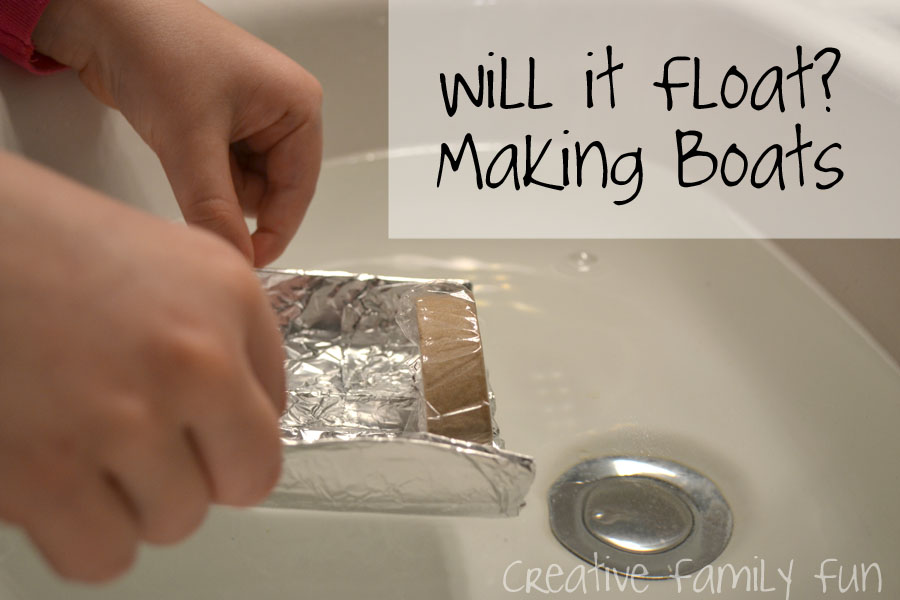
Also, we were making a speedboat, so shiny and flashy seemed perfect. So we got out the aluminum foil and covered the tube. We had already cut the tube so that it would open up and lay flat(ish). It still had a bit of a curve to it, which worked in our favor.

After it was covered, we taped down the loose ends. Then we started bending.

We started with a sharp crease in the middle for a small “v” to imitate the bottom of a speed boat.

We bent the cardboard more to make a flat bottom and curved sides.

Now it was time for the window. Lizzie wouldn’t let me forget the window.

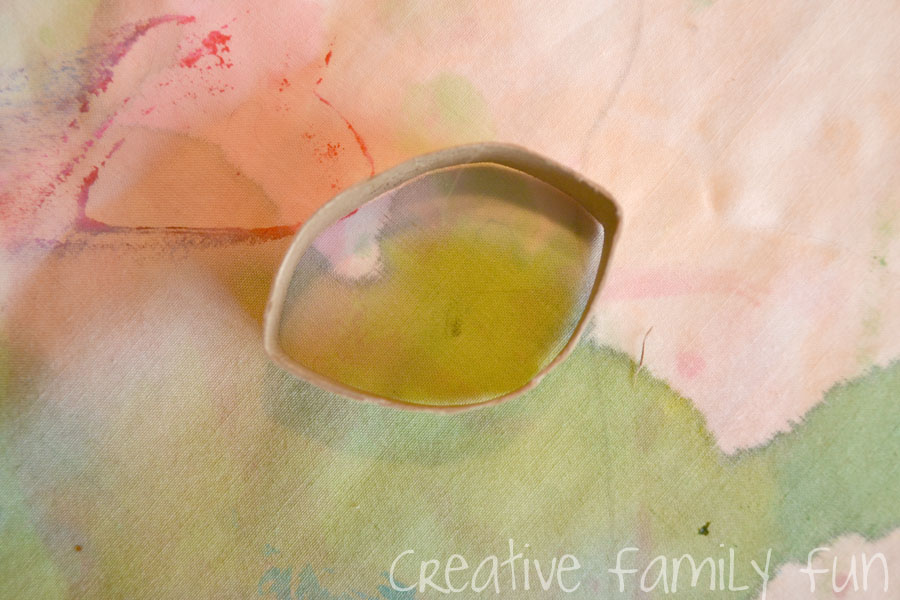
We cut a thin strip off another tube, flattened it a bit and covered it in plastic wrap. We then taped it to the front of our boat.

It was time to test out our boat! Did we do it?

Lizzie filled the sink with water and carefully put her boat in.

Guess what? We did it! It floated! Success!

A few final thoughts:

In hindsight, we should have bent up the front and back of the boat to keep water from seeping into the boat.

Also, despite out best efforts, the cardboard did end up getting soggy (after a lot of play).

But, all in all, I would consider this experiment a success. We started with nothing and with a bit of problem solving, we ended up with a speed boat. Isn’t that what learning is all about?

Have you ever just run with a wild idea your kid had? I’d love to hear about it!

10 Fun Ways to Learn Math

February 17, 2012 By Terri Thompson

When I was a kid, I rarely enjoyed math. All of those worksheets, memorization, and lists of problems to solve just did not interest me.

There’s just no fun in that!

Luckily, math doesn’t have to be boring. And for children just learning the concepts of counting and math, it can be loads of fun.

Here is my list of 10 fun ways to learn math.

Math doesn't have to be boring especially if you learn with one of these hands-on and fun ways to learn math. Play and learn at the same time.

Disclosure: There are Amazon Affiliate and other affiliate links in this article which means, at no additional cost to you, we could receive compensation for our recommendations. You can read our full disclosure policy on our Disclosure Page for more details.

10 Fun Ways to Learn Math

Play games.

Get out a deck of cards and start playing. Number recognition, greater than and less than, and addition are all very fun concepts to learn with a deck of cards. Here’s a post by Imagination Soup that lists several games you could play.

Get out your blocks.

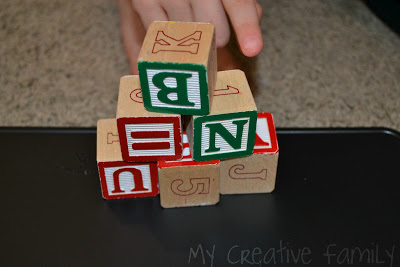
Recently my girls and I had great fun practicing our counting and basic addition with our building blocks. You can also learn about subtraction or even basic geometry with your blocks. Start building and you’ll be surprised at what your kids learn.

Math doesn't have to be boring especially if you learn with one of these hands-on and fun ways to learn math. Play and learn at the same time.

Learn about measurement and estimation with non-standard units.

NurtureStore used Legos to measure with, while The Imagination Tree used hand prints. Better Than Homework used heart doilies for a fun Valentine’s Day twist.

Come up with your own non-standard unit. Maybe you’ll use blocks, foot prints, or even whole body lengths to measure. Try to guess how many blocks you’ll need to measure the length of a book. Have fun and let your kids use their problem-solving skills.

Play with pattern blocks.

Make patterns and have your kids replicate them. Create shapes using the pattern blocks. PreKinders has a lot of pattern block mats you can use to help your kids create pictures with the pattern blocks. (I found our pattern blocks at Discount School Supply.)

Hunt for shapes

Learn about shapes by going on a Shape Hunt. Send the kids all over the house looking for examples of different shapes.

Math doesn't have to be boring especially if you learn with one of these hands-on and fun ways to learn math. Play and learn at the same time.

Get out your play dough

Sculpt play dough into numbers or shapes.

Or, you could roll out lengths of play dough and practice cutting and measuring with a ruler, just like this example at Shannon’s Tot School.

Find fun ways to practice counting

For example, practice counting with a counting maze. Hands On: As We Grow shares this wonderful and fun idea!

Practice math with candy.

You can practice counting, estimating, graphing, sorting, adding, subtracting, and more using candy.

Creative Connections with Kids shows you some fun ideas with M&M’s and Quirky Momma shows you all the math fun you can have with a bag of Skittles.

Have some counting fun with nursery rhymes.

Your littlest ones will love counting along with some of their favorite nursery rhymes such as One, Two, Buckle My Shoe and Five Little Monkeys.

Get active.

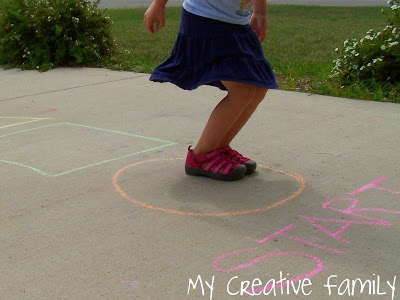
Play hopscotch or jump rope to practice counting.

You could also mix it up a little bit and play shape hopscotch instead of traditional hopscotch.

Math doesn't have to be boring especially if you learn with one of these hands-on and fun ways to learn math. Play and learn at the same time.

Bonus Activity

There are many, many books full of math activities that you could find at your local library. Two of my favorites are Math Play! by Diane McGowan and Mark Schrooten and MathArts: Exploring Math Through Art for 3 to 6 Year Olds by MaryAnne Kohl.

Do you have any ideas for fun ways to learn math?

Art & Writing Corner

February 15, 2012 By Terri Thompson

There are so many wonderful and inspiring play and learning spaces all over the Web.

Some are large taking up entire rooms and while wonderful, that’s just not realistic for my family.

So, when Lizzie started showing a lot of interest in both writing and drawing, I knew I wanted to set up an area that she could go to and have plenty of materials at her disposal.

A lot of my inspiration for this area came from Mariah Bruehl and her blog Playful Learning. Her writing caddy was foremost on my mind while creating this space.

Disclosure: There are Amazon Affiliate and other affiliate links in this article which means, at no additional cost to you, we could receive compensation for our recommendations. You can read our full disclosure policy on our Disclosure Page for more details.

We had a small, unused cabinet that I moved to a sunny corner of our living room.

The girls’ table is set up next to the cabinets. Then, I gathered baskets, boxes, empty cans, and plenty of art and writing supplies.

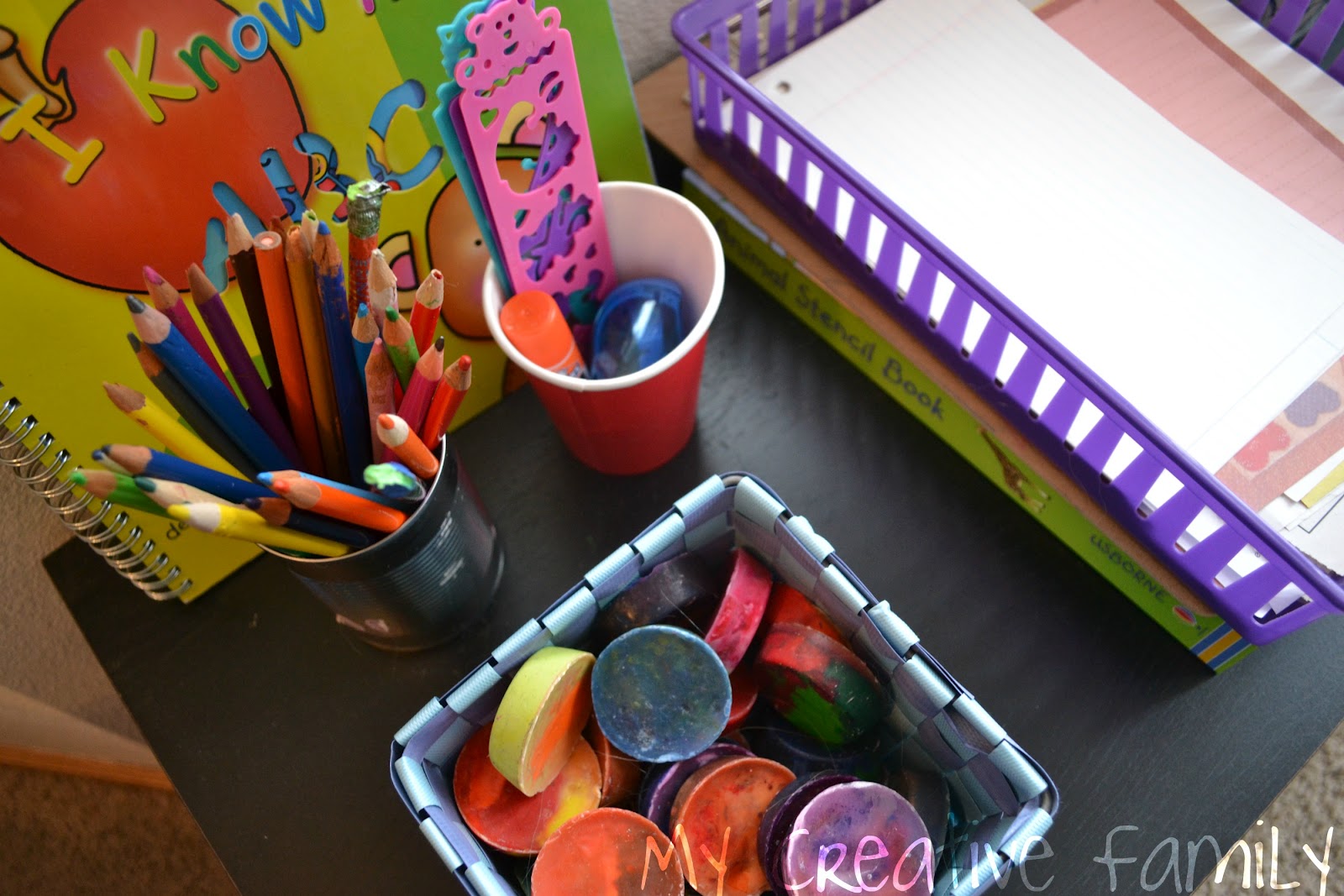
The purple basket is full of all kinds of paper. Plain paper, lined paper, old stationary, colored paper, and even a few coloring pages. In addition to the various types of paper, I also made sure there were different sizes as well.

Then, I set out our box of crayons, markers, colored pencils, and recycled muffin tin crayons.

We have an A,B,C stencil book I found at our library’s book sale that I added to the area. I also included a cup with a few more stencils, a pencil sharpener, and glue sticks.

This is an independent area that the girls can use anytime they want.

It’s also in an area of our house that we spend the most time in, which was very important to me.

Now the girls are able to draw, color, or write anytime it strikes their fancy. And, I have piles and piles of drawings to attest to how much they use this area!

A learning space doesn’t have to be large or expensive to set up.

It could be a small corner of a room or it could even be portable in a basket or bin. But, it’s a wonderful way to encourage a budding interest in your child!

Do you have any special learning or play spaces in your home?

  • « Go to Previous Page
  • Page 1
  • Interim pages omitted …
  • Page 54
  • Page 55
  • Page 56
  • Page 57
  • Page 58
  • Interim pages omitted …
  • Page 61
  • Go to Next Page »

Primary Sidebar

Footer

Categories

Archives

Copyright © 2026 · Designed by The Blog Surgery

Creative Family Fun uses cookies to improve your experience. These cookies provide feedback to our analytics and advertisers. We use the information to track views of the site, where you go and to know if you are a regular visitor or brand new as well as provide a personalized experience where possible. We'll assume you're ok with this, but you can opt-out if you wish.Accept Reject Read More
Privacy & Cookies Policy

Privacy Overview

This website uses cookies to improve your experience while you navigate through the website. Out of these, the cookies that are categorized as necessary are stored on your browser as they are essential for the working of basic functionalities of the website. We also use third-party cookies that help us analyze and understand how you use this website. These cookies will be stored in your browser only with your consent. You also have the option to opt-out of these cookies. But opting out of some of these cookies may affect your browsing experience.
Necessary
Always Enabled
Necessary cookies are absolutely essential for the website to function properly. This category only includes cookies that ensures basic functionalities and security features of the website. These cookies do not store any personal information.
Non-necessary
Any cookies that may not be particularly necessary for the website to function and is used specifically to collect user personal data via analytics, ads, other embedded contents are termed as non-necessary cookies. It is mandatory to procure user consent prior to running these cookies on your website.
SAVE & ACCEPT