• Skip to secondary menu
  • Skip to main content
  • Skip to primary sidebar
  • Skip to footer
  • Home
  • About
    • Email Me
    • Disclosure & Copyright
  • Start Here
  • Subscribe
  • Privacy Policy
  • Books for Moms

Creative Family Fun

Your one-stop shop for kids activities and family fun

  • Facebook
  • Instagram
  • Pinterest
  • Twitter
  • Spelling Activities
  • Family Fun
  • STEM
  • Movie Night
  • Toddler Activities

Terri Thompson

Exploring Nature: Investigating Trees

April 19, 2012 By Terri Thompson

We took a trip out to our side yard recently to take a close look at our young apple tree.

We were talking about the different parts of trees and learning about how they grew.

We were specifically taking a look at the apple tree because we wanted to know how apples grew.

Disclosure: There are Amazon Affiliate and other affiliate links in this article which means, at no additional cost to you, we could receive compensation for our recommendations. You can read our full disclosure policy on our Disclosure Page for more details.
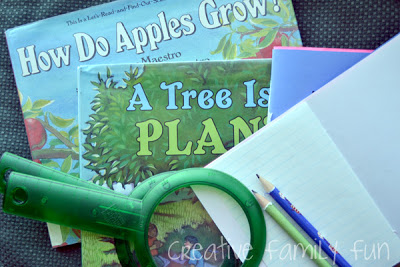
We gathered our supplies.We brought our magnifying glasses for observation.

Pencils and homemade notebooks for recording our observations.

We also brought two books, A Tree Is a Plant (Let’s-Read-and-Find-Out Science) by Clyde Robert Bulla and How Do Apples Grow? by Betsy Maestro, for research.
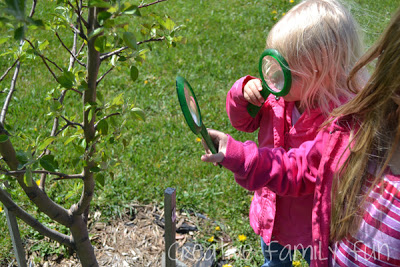
 

One of my goals with our nature studies, is to teach the girls about observation and drawing their own conclusions using what they’ve observed.

We talked about the bark of the tree, then we looked at it through our magnifying glasses and felt it with our fingers.

We talked about how apples are formed and looked all over to see if we could see any baby apples.

We also talked about the roots of a tree and then discussed why we couldn’t see the roots.
Here are some great questions to ask when teaching about observation.

What do you see?

What color is it?

What size is it?

Where is it located?

How does it feel? Bumpy, smooth, rough, etc.?

Does it have a scent?

Lead your kids a bit and help them learn to make observations.

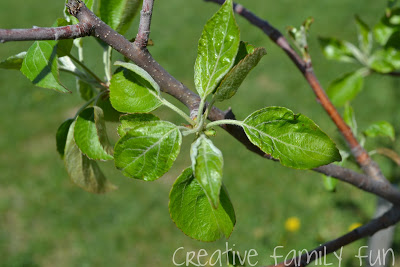
For instance, we learned that the bark of a young apple tree is mostly smooth with a few bumps.

We also discovered some spots where there was yellow underneath the brown.

It’s amazing the things we discovered when we looked closely!
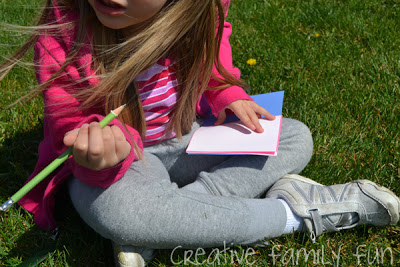
While we were observing and talking about trees, Lizzie recorded some of her own observations through drawing.

She copied a drawing of a baby tree from one of the books as well as drawing a fully-grown orange tree.

Older kids can use the space to record all the characteristics of what they are observing and the conclusions they drew from it. Have them draw a tree and label the parts or just try drawing what they are observing.

Do you like to look closely at nature? Have you ever been surprised at what you saw?

Story Time: Earth Day

April 18, 2012 By Terri Thompson

Favorite children's books for Earth Day.

Books are one of the first things I reach for when I want to teach my girls about something.

So, when it came time to start talking about Earth Day, I went to the library. These books are all appropriate for preschoolers, plus older kids will enjoy them too.

When searching for Earth Day books, choose ones about recycling, planting, trees, gardening, energy reduction, or the climate. Do you have any favorite books about Earth Day?

Disclosure: There are Amazon Affiliate and other affiliate links in this article which means, at no additional cost to you, we could receive compensation for our recommendations. You can read our full disclosure policy on our Disclosure Page for more details.

Curious George Plants A Tree
by Margret & H.A. Rey: George learns about the environment and wants to do something to help, so he decides to plant a tree.

Be a Friend to Trees (Let’s-Read-and-Find-Out, Stage 2)
by Patricia Lauber: Learn about the importance of trees and how we can be a friend to trees.
 
We Planted a Tree
by Diane Muldrow: Learn about the benefits of trees through two families who plant two trees in different corners of the world.
 
Compost Stew: An A to Z Recipe for the Earth by Mary McKenna Siddals: Learn all about compost through fun rhyming verse.
 
The EARTH Book by Todd Parr: Colorful illustrations and playful text help explain the environment to young children.
 
The Lorax by Dr. Seuss: No Earth Day book collection would be complete without including The Lorax! “Unless someone like you cares a whole awful lot, nothing is going to get better. It’s not.”
 

You may also like one of these Earth Day posts:

Favorite Craft Supplies From the Recycle Bin

Activities for Kids Who Want to Save the Earth

Earth Day Pledge: Turn Off the Lights

Weather Wiz Kids

April 17, 2012 By Terri Thompson

(via Weather Wiz Kids)

I stumbled across Weather Wiz Kids when I was researching my “10 Ways to Learn About the Weather” post.

I was so happy to discover such a comprehensive weather website created for kids. You’ll find explanations of weather phenomena written for kids, fun facts, weather safety information, experiments, games, and even jokes. You’ll find information there for all ages of kids, their parents, and teachers.

If you’re looking for ways to teach about weather, Weather Wiz Kids should be your first stop!

Disclosure: There are Amazon Affiliate and other affiliate links in this article which means, at no additional cost to you, we could receive compensation for our recommendations. You can read our full disclosure policy on our Disclosure Page for more details.

Weather Wiz Kids was started by Crystal Wick, a meteorologist from Indiana. I recently asked Crystal more about herself and her Website.

(Dark clouds over western Colorado)

Why did you start Weather Wiz Kids?

I started Weather Wiz Kids back in 2003 when I was working as a morning meteorologist in New Orleans, Louisiana. I visited several schools to teach kids about weather, but I couldn’t answer everyone’s questions. So, I decided to create a website to teach kids about weather and allow them to email me any of their weather questions.

What can someone expect to find on Weather Wiz Kids?

Weather Wiz Kids is an educational website for teachers, parents and kids. You will find an ample amount of kid-friendly information on all types of weather and even natural disasters like volcanoes and earthquakes.

When did you become interested in weather? Why?

Ever since I was a child, I have always been fascinated with the weather. I remember going outside with my father and watching thunderstorms pass by. During one thunderstorm in particular, a tornado ripped through my hometown of Kendallville, Indiana and just missed my grandparents’ house. It was one of the scariest moments of my life and is one of the reasons I am a meteorologist today.

What are the benefits of learning about weather?

I believe knowledge is power. Weather impacts all of us, from what we wear each day to the crops that grow to provide us food. Understanding weather is important, because it can save our lives. Knowing what to do in a severe weather situation or as a hurricane approaches can mean the difference between life and death. It’s important that all of us have a family disaster plan in place.

What is your favorite weather phenomenon?

I’m fascinated by tornadoes. It’s amazing to me the strength and power they have and the destruction they leave behind. Every state in the United States has been effected by a tornado, so I can’t express how important it is to have a family disaster plan in place.

Weather Wiz Kids has many ideas for weather experiments you can do in your home. I asked Crystal which would be best for preschool-aged children and she suggested “Make Your Hair Stand Up” and “Tornado in a Bottle.” You can check out the “Weather Experiments” page for 39 different experiments!

Thank you Crystal for answering my questions! If you want to learn more about Crystal and weather, please visit Weather Wiz Kids or follow Weather Wiz Kids on Facebook.

 
Crystal Wicker
Website/Facebook

Tips for Observing Nature With Small Children

April 16, 2012 By Terri Thompson

Since we are going to be spending so much time exploring nature, I thought it was important to teach the girls how to observe nature.

We recently took a trip to a local nature center and had some incredible opportunities for observation.

We saw turtles and geese and heard frogs and many varieties of birds.

We were very lucky to have chanced upon the goose in the picture above, who let us watch him for quite awhile before swimming away. Of course, he wouldn’t have stayed around for as long if we hadn’t been following some simple rules for observing nature.

When relaying these tips to children, you need to tell them why they are following these rules. They are much more likely to be good observers of nature if they know the reasons behind the rules.

Disclosure: There are Amazon Affiliate and other affiliate links in this article which means, at no additional cost to you, we could receive compensation for our recommendations. You can read our full disclosure policy on our Disclosure Page for more details.

Tips for Exploring Nature

1. Be Quiet. This one is absolutely essential. Talking in whispers and quiet voices can sometimes be okay, but other occasions need absolute quiet. Why? Animals, birds, and even insects are naturally afraid of humans. We need to respect them and show them that we won’t hurt them. Remaining quiet will help ease the fear.

2. Be Still. Any quick or sudden movements will frighten wildlife. Why? This is the same reason why we remain quiet. We don’t want to frighten the animal. Slow, quiet motions are best. Find a spot to sit; it’s much easier to stay still while sitting.

3. Stay a safe distance away. As the adult, it’s up to you to use your common sense. For the safety of your kids and the wildlife, you need to stay a safe distance away. If you want a closer look, use binoculars. We were observing geese and turtles, both animals that would not harm us if we stayed a safe distance away. Other animals are best observed at zoos or other controlled environments.

4. Use all your senses. Teach the kids to not just use their eyes. Your ears and nose are also important tools to observation. What kind of sounds does the animal make? What do you smell? Observation is more than just seeing.

Observing birds is a great way to teach young children the rules of observing nature.

Practice observing the different characteristics of the bird. What do they look like? What color is the beak? The head? What kind of noise does the bird make?

Record the characteristics and then use a bird guide to determine what kind of bird you are looking at.

Learning to observe nature is an important skill to have because the best way to learn about nature is through observation. What are your best tips for observing nature with young children?

**Many thanks to my mom for providing the two goose pictures.**

Weekends: Examine the Small Things

April 14, 2012 By Terri Thompson

It’s so easy to overlook the little things, isn’t it?

I was on a hike with the family and the girls were moving as fast as they could. They were excited and full of energy. They were ready to move.

Suddenly, a voice from behind said, “Slow down! You just missed a pretty flower.”

They circled back and looked.

Sure enough, in all of their excitement, they had walked right by a pretty spring flower poking out of a bed of dead leaves.

We talked about slowing down, looking around us, and paying attention to the small things.

Do you ever do that? Go so fast through life that you miss the little things.

Do you miss the kind words, giggles, funny stories, or whispered secrets because you feel so busy.

I know I do! Laundry needs to be done, work is pulling in many directions, the problems of the world weigh heavy. It’s so hard to look beyond that.

But, it’s important to look beyond that. No, you don’t have to push aside all of your other responsibilities. It just takes a few minutes. Look down, look around, open your eyes and pay attention to all the bits of beauty and happiness that are around you.

Why not take this weekend to slow down a bit?

Stop and look, listen, and smile. That’s my plan.

I want to see the little things this weekend and appreciate their beauty! How about you?

  • « Go to Previous Page
  • Page 1
  • Interim pages omitted …
  • Page 156
  • Page 157
  • Page 158
  • Page 159
  • Page 160
  • Interim pages omitted …
  • Page 190
  • Go to Next Page »

Primary Sidebar

Footer

Categories

Archives

Copyright © 2026 ยท Designed by The Blog Surgery

Creative Family Fun uses cookies to improve your experience. These cookies provide feedback to our analytics and advertisers. We use the information to track views of the site, where you go and to know if you are a regular visitor or brand new as well as provide a personalized experience where possible. We'll assume you're ok with this, but you can opt-out if you wish.Accept Reject Read More
Privacy & Cookies Policy

Privacy Overview

This website uses cookies to improve your experience while you navigate through the website. Out of these, the cookies that are categorized as necessary are stored on your browser as they are essential for the working of basic functionalities of the website. We also use third-party cookies that help us analyze and understand how you use this website. These cookies will be stored in your browser only with your consent. You also have the option to opt-out of these cookies. But opting out of some of these cookies may affect your browsing experience.
Necessary
Always Enabled
Necessary cookies are absolutely essential for the website to function properly. This category only includes cookies that ensures basic functionalities and security features of the website. These cookies do not store any personal information.
Non-necessary
Any cookies that may not be particularly necessary for the website to function and is used specifically to collect user personal data via analytics, ads, other embedded contents are termed as non-necessary cookies. It is mandatory to procure user consent prior to running these cookies on your website.
SAVE & ACCEPT