• Skip to secondary menu
  • Skip to main content
  • Skip to primary sidebar
  • Skip to footer
  • Home
  • About
    • Email Me
    • Disclosure & Copyright
  • Start Here
  • Subscribe
  • Privacy Policy
  • Books for Moms

Creative Family Fun

Your one-stop shop for kids activities and family fun

  • Facebook
  • Instagram
  • Pinterest
  • Twitter
  • Spelling Activities
  • Family Fun
  • STEM
  • Movie Night
  • Toddler Activities

Preschool Activities

Go Outside: Counting Walk

June 5, 2012 By Terri Thompson

How many mailboxes can you count on this walk?

1,2,3,4,5!

Walks are always a great way to get outside and exercise with the kids.

But, you don’t have to just go on a walk. When I counted down the 10 Ways to Make a Walk More Fun, the first item listed was to go on a counting walk. This has since become one of our favorite ways to get outside and go walking.

We typically walk around our neighborhood counting whatever we can find. You can also take a walk through the park or around downtown.

Counting walks are fun anywhere! This is a fun game for kids who are just learning to how to count all the way up through the preschool years. My 5-year-old requests counting walks often.

Disclosure: There are Amazon Affiliate and other affiliate links in this article which means, at no additional cost to you, we could receive compensation for our recommendations. You can read our full disclosure policy on our Disclosure Page for more details.
How many trees are in front of that house?

How many red cars do you see on this street? How many flagpoles?

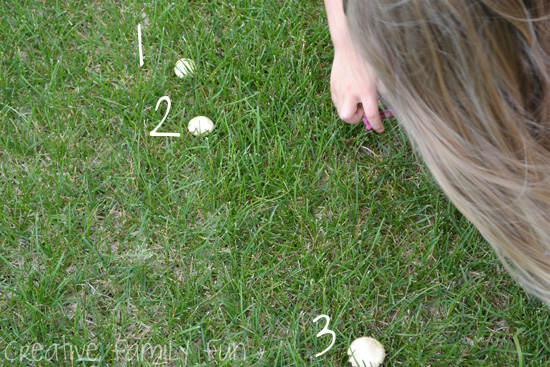
How many mushrooms are in the corner of this lawn?

You get the picture. Pick an item that you see and have the kids start counting.
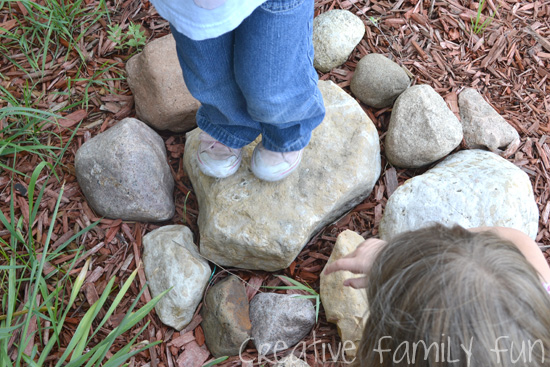
We counted the rocks in our front garden and all the bird feeders we saw.

I would ask a question and the kids would start counting.
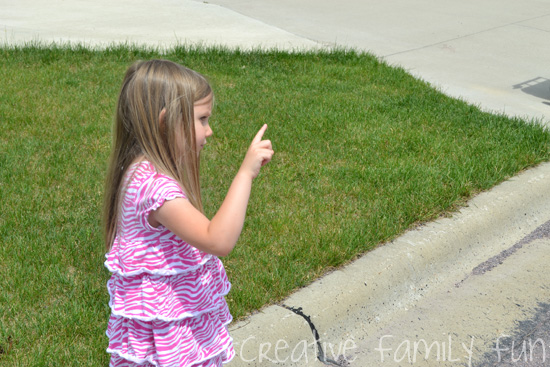
And then we turned a corner and started counting some more!

We counted the cracks along the curb and even the holes in the storm drains. (They always have to stop and count these!)

Our counting walks always result in good fun, a few giggles, and lots of exercise.
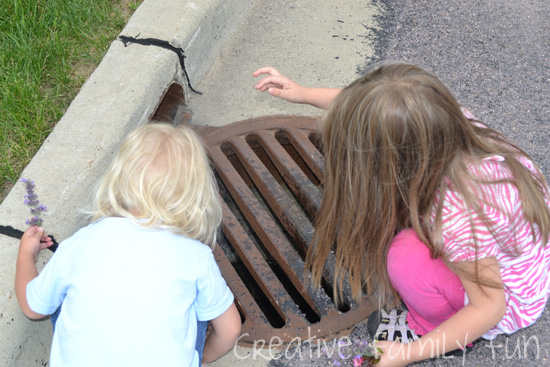
The next time you go for a walk with your kids, start counting!

It’s a fun way for kids to learn their numbers and great practice for kids that can already count.

Make it a family adventure!

Cost: free
Planning time: none
Ages: 5 and under (Older kids can be involved by asking the questions.)
Time needed: 15-30 minutes

Keep this idea in your back pocket because it can be done anytime and anywhere. Extend the family time after dinner by going for a walk. Or, tame the kids’ extra energy with a counting walk in the afternoon.
We Make Music

April 9, 2012 By Terri Thompson

Awhile ago, I asked my friend Angelique Felix for help. I was hoping to provide you with a post about music play. Angelique graciously offered to write a guest post on this subject, and today I am happy to be able to share it with you! Thank you Angelique!

**************************

This post I dedicate to a big love in my life and the joy it brought me and many of the children I encounter – MUSIC. Written for my lovely friend Terri of Creative Family Fun.

Children are magically drawn to music. A big master of music said: “If children hear fine music from the
day of their birth and learn to play it, they develop sensitivity, discipline and endurance. They get a beautiful heart.” – Shinichi Suzuki (Japanese violinist and teacher who introduced millions of children to his  musical “Suzuki Method”)

Disclosure: There are Amazon Affiliate and other affiliate links in this article which means, at no additional cost to you, we could receive compensation for our recommendations. You can read our full disclosure policy on our Disclosure Page for more details.

The importance of tones, melodies and music for our children’s development start early.

Since the fourth month after conception kids have the ability to listen to the rhythm and melody of their mother’s voice. The newborn child will likely react positively and show recognition of songs sung by its parents during pregnancy. Reseacher Annie Murphy on TED explains that newborns can even cry in the dialect of their mother! The sense of melody and rhythm begins in the womb and will be mostly formed up to three years of age.

Letting your children hear music, move to music and join in when you sing and play, will give the child’s brain and memory a good boost.

My own experiences show how children playfully learn a second language through music. I play in English with Italian 2 to 3 years old. They hear this second language just a couple a times a week and have a limited vocabulary of their own language. The lack they have in expressing themselvs in words has never been an obstacle to include them in my games.

The approach I use, inspired by super simple learning,  is seeing the
English language as a variety of music and expose the kids to it’s different melodies and rhythms.

Some advices how to use music and dancing with children:

Repeat the same song – Young children love to repeat the same things over and over again. They feel safe if they know what will happen.

Sing Slow – be aware to sing slow,this makes it easier for children to participate and understand words and melody.

Tone height – The voice of a child is higher as the one of the adult. Adapt your singing to their level.

Action songs – Song with actions help him remember the words and tune.

Moving to Music – Expose your child to a variety of music from rock to classical ballet and encourage him to move in different ways.

For babies and toddlers: If your child is little let him sit on your knee or rest in your arms while you move to the
music. Move up and down with the tones, slow and fast with the rythm, soft and strong with the volume. This help the child to listen and respond to all aspects of the sounds.

For older children: Clap out the rhythm or tap it out on the table.

Use instruments: Make them yourselves: all it need is a used box and two wooden spoons! Or empty Bottles with pasta, rice, or whatever you like to listen to inside.

Musical play is a lovely tool that stimulates your child’s social, emotional and cognitive development. And the best is that you can use music everywhere and anytime: Inside or outdoors, as we show you in this
cute video
! Have fun!

If you would like to see MORE of my videos, please visit me HERE.Angelique Felix

********************

Angelique Felix believes in play. She lives in Italy and provides many play sessions for both parents and children. She’s also an instructor in infant massage. Angelique works with the Reggio Emilia-approach in her play sessions. Please visit Angelique’s blog or her YouTube channel to learn more about her and her approach to playful learning.

10 Fun Ways to Learn Math

February 17, 2012 By Terri Thompson

When I was a kid, I rarely enjoyed math. All of those worksheets, memorization, and lists of problems to solve just did not interest me.

There’s just no fun in that!

Luckily, math doesn’t have to be boring. And for children just learning the concepts of counting and math, it can be loads of fun.

Here is my list of 10 fun ways to learn math.

Math doesn't have to be boring especially if you learn with one of these hands-on and fun ways to learn math. Play and learn at the same time.

Disclosure: There are Amazon Affiliate and other affiliate links in this article which means, at no additional cost to you, we could receive compensation for our recommendations. You can read our full disclosure policy on our Disclosure Page for more details.

10 Fun Ways to Learn Math

Play games.

Get out a deck of cards and start playing. Number recognition, greater than and less than, and addition are all very fun concepts to learn with a deck of cards. Here’s a post by Imagination Soup that lists several games you could play.

Get out your blocks.

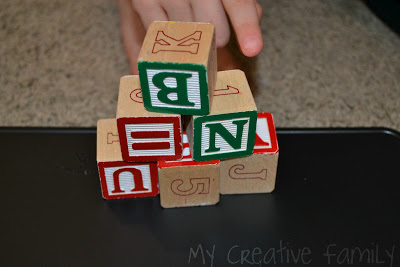
Recently my girls and I had great fun practicing our counting and basic addition with our building blocks. You can also learn about subtraction or even basic geometry with your blocks. Start building and you’ll be surprised at what your kids learn.

Math doesn't have to be boring especially if you learn with one of these hands-on and fun ways to learn math. Play and learn at the same time.

Learn about measurement and estimation with non-standard units.

NurtureStore used Legos to measure with, while The Imagination Tree used hand prints. Better Than Homework used heart doilies for a fun Valentine’s Day twist.

Come up with your own non-standard unit. Maybe you’ll use blocks, foot prints, or even whole body lengths to measure. Try to guess how many blocks you’ll need to measure the length of a book. Have fun and let your kids use their problem-solving skills.

Play with pattern blocks.

Make patterns and have your kids replicate them. Create shapes using the pattern blocks. PreKinders has a lot of pattern block mats you can use to help your kids create pictures with the pattern blocks. (I found our pattern blocks at Discount School Supply.)

Hunt for shapes

Learn about shapes by going on a Shape Hunt. Send the kids all over the house looking for examples of different shapes.

Math doesn't have to be boring especially if you learn with one of these hands-on and fun ways to learn math. Play and learn at the same time.

Get out your play dough

Sculpt play dough into numbers or shapes.

Or, you could roll out lengths of play dough and practice cutting and measuring with a ruler, just like this example at Shannon’s Tot School.

Find fun ways to practice counting

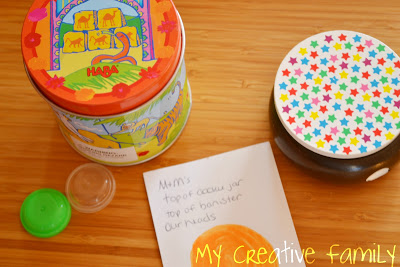
For example, practice counting with a counting maze. Hands On: As We Grow shares this wonderful and fun idea!

Practice math with candy.

You can practice counting, estimating, graphing, sorting, adding, subtracting, and more using candy.

Creative Connections with Kids shows you some fun ideas with M&M’s and Quirky Momma shows you all the math fun you can have with a bag of Skittles.

Have some counting fun with nursery rhymes.

Your littlest ones will love counting along with some of their favorite nursery rhymes such as One, Two, Buckle My Shoe and Five Little Monkeys.

Get active.

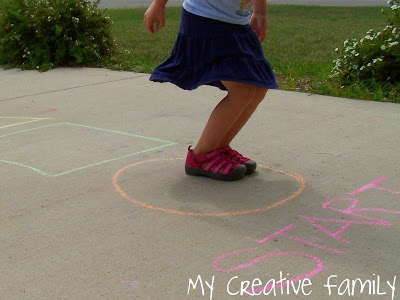
Play hopscotch or jump rope to practice counting.

You could also mix it up a little bit and play shape hopscotch instead of traditional hopscotch.

Math doesn't have to be boring especially if you learn with one of these hands-on and fun ways to learn math. Play and learn at the same time.

Bonus Activity

There are many, many books full of math activities that you could find at your local library. Two of my favorites are Math Play! by Diane McGowan and Mark Schrooten and MathArts: Exploring Math Through Art for 3 to 6 Year Olds by MaryAnne Kohl.

Do you have any ideas for fun ways to learn math?

Art & Writing Corner

February 15, 2012 By Terri Thompson

There are so many wonderful and inspiring play and learning spaces all over the Web.

Some are large taking up entire rooms and while wonderful, that’s just not realistic for my family.

So, when Lizzie started showing a lot of interest in both writing and drawing, I knew I wanted to set up an area that she could go to and have plenty of materials at her disposal.

A lot of my inspiration for this area came from Mariah Bruehl and her blog Playful Learning. Her writing caddy was foremost on my mind while creating this space.

Disclosure: There are Amazon Affiliate and other affiliate links in this article which means, at no additional cost to you, we could receive compensation for our recommendations. You can read our full disclosure policy on our Disclosure Page for more details.

We had a small, unused cabinet that I moved to a sunny corner of our living room.

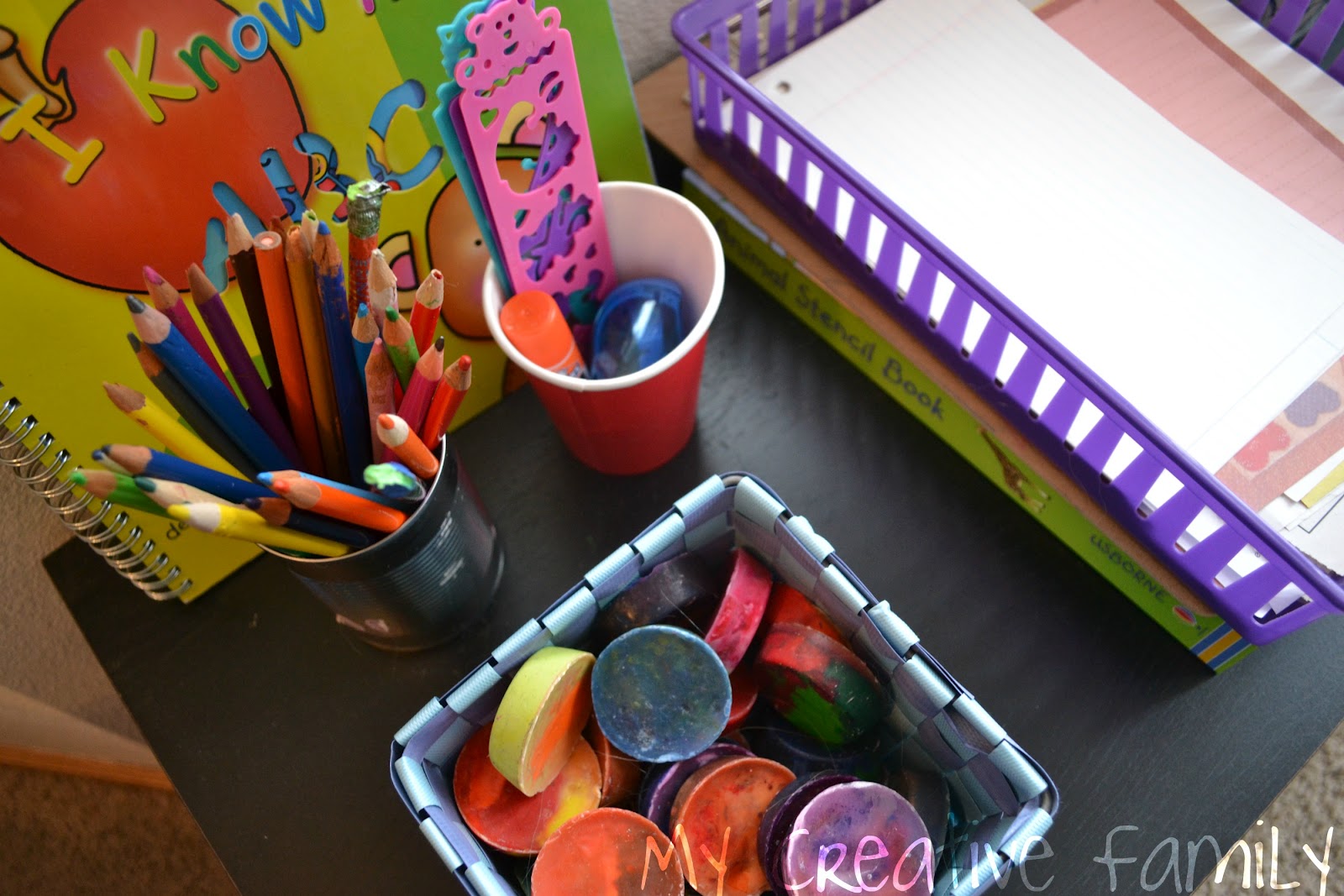
The girls’ table is set up next to the cabinets. Then, I gathered baskets, boxes, empty cans, and plenty of art and writing supplies.

The purple basket is full of all kinds of paper. Plain paper, lined paper, old stationary, colored paper, and even a few coloring pages. In addition to the various types of paper, I also made sure there were different sizes as well.

Then, I set out our box of crayons, markers, colored pencils, and recycled muffin tin crayons.

We have an A,B,C stencil book I found at our library’s book sale that I added to the area. I also included a cup with a few more stencils, a pencil sharpener, and glue sticks.

This is an independent area that the girls can use anytime they want.

It’s also in an area of our house that we spend the most time in, which was very important to me.

Now the girls are able to draw, color, or write anytime it strikes their fancy. And, I have piles and piles of drawings to attest to how much they use this area!

A learning space doesn’t have to be large or expensive to set up.

It could be a small corner of a room or it could even be portable in a basket or bin. But, it’s a wonderful way to encourage a budding interest in your child!

Do you have any special learning or play spaces in your home?

Building Blocks and Math Fun

February 8, 2012 By Terri Thompson

Disclosure: There are Amazon Affiliate and other affiliate links in this article which means, at no additional cost to you, we could receive compensation for our recommendations. You can read our full disclosure policy on our Disclosure Page for more details.

When I picked up the book Jack the Builder (MathStart 1) by Stuart J. Murphy at the library, I didn’t expect to have so much fun with it.

We learned a new math concept, counting on, while playing with blocks. It doesn’t get any better than that!

Jack the Builder is part of the MathStart 1 series of books.

This is a series that teaches kids about basic math concepts through stories. The book we chose talked about counting on, an early step to addition.

If you have three blocks then add two more, start counting from 3 then 4, 5. You have 5 blocks.

Jack kept adding more and more blocks all the while encouraging the reader to add with him.

What really got my girls excited was Jack’s imagination.

He didn’t just build simple towers with blocks, he built hot dog stands, boats, and rockets.

We were encouraged to get out our blocks and see what we could build.

We played and talked about math for an entire afternoon.

We built towers, circus trains, and village by the sea.

We built wide structures and high structures.

We had a competition to see who could build the highest tower.

All the while, we were counting, adding, and subtracting. This was the perfect way to learn a little about math!

Do you have any sneaky ideas for teaching math skills?

  • « Go to Previous Page
  • Page 1
  • Interim pages omitted …
  • Page 7
  • Page 8
  • Page 9
  • Page 10
  • Page 11
  • Page 12
  • Go to Next Page »

Primary Sidebar

Footer

Categories

Archives

Copyright © 2025 · Designed by The Blog Surgery

Creative Family Fun uses cookies to improve your experience. These cookies provide feedback to our analytics and advertisers. We use the information to track views of the site, where you go and to know if you are a regular visitor or brand new as well as provide a personalized experience where possible. We'll assume you're ok with this, but you can opt-out if you wish.Accept Reject Read More
Privacy & Cookies Policy

Privacy Overview

This website uses cookies to improve your experience while you navigate through the website. Out of these, the cookies that are categorized as necessary are stored on your browser as they are essential for the working of basic functionalities of the website. We also use third-party cookies that help us analyze and understand how you use this website. These cookies will be stored in your browser only with your consent. You also have the option to opt-out of these cookies. But opting out of some of these cookies may affect your browsing experience.
Necessary
Always Enabled
Necessary cookies are absolutely essential for the website to function properly. This category only includes cookies that ensures basic functionalities and security features of the website. These cookies do not store any personal information.
Non-necessary
Any cookies that may not be particularly necessary for the website to function and is used specifically to collect user personal data via analytics, ads, other embedded contents are termed as non-necessary cookies. It is mandatory to procure user consent prior to running these cookies on your website.
SAVE & ACCEPT