• Skip to secondary menu
  • Skip to main content
  • Skip to primary sidebar
  • Skip to footer
  • Home
  • About
    • Email Me
    • Disclosure & Copyright
  • Start Here
  • Subscribe
  • Privacy Policy
  • Books for Moms

Creative Family Fun

Your one-stop shop for kids activities and family fun

  • Facebook
  • Instagram
  • Pinterest
  • Twitter
  • Spelling Activities
  • Family Fun
  • STEM
  • Movie Night
  • Toddler Activities

Learning Activities for Kids

Sewing Circles: Simple Shapes to Sew

July 23, 2012 By Terri Thompson

After learning all about squares, we moved on to the circle.

One project I set up for the girls was this simple sewing projects.

I was able to combine two things in one project, learning shapes and fine motor skills.

Disclosure: There are Amazon Affiliate and other affiliate links in this article which means, at no additional cost to you, we could receive compensation for our recommendations. You can read our full disclosure policy on our Disclosure Page for more details.
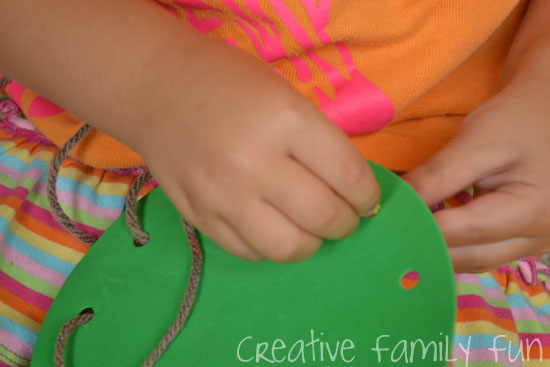
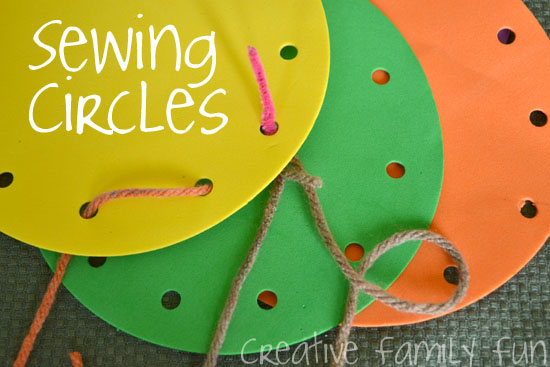
Awhile ago, I had purchased a package of foam circles from the dollar store.

When we started talking about circles, I pulled them out. I knew we would find a way to use them.

One idea I came up with was these sewing circles.

I took my hole punch and punched holes around the outer edge of a few of the circles. Voila, the circles were ready to go.
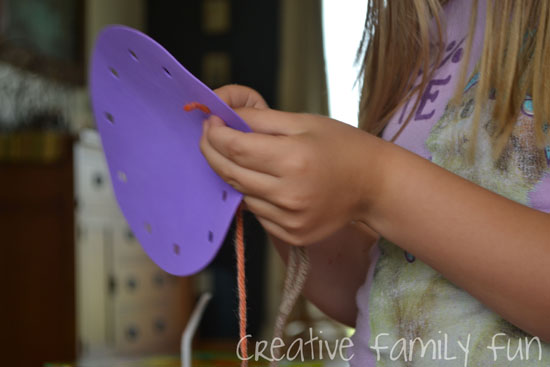
For the needles and thread, I cut a length of yarn and tied a thick knot in one end.

I made needles from a small bit of pipe cleaner. I made a small loop of pipe cleaner at one end, threaded the yarn through, then twisted the looped pipe cleaner nice and tight. The “needle” won’t come off and it helps the girls with their sewing.

I packaged it all up in a cute little basket. Now the girls can grab their sewing basket anytime they’re in the mood for a little sewing.
Exploring Japan: Haiku

July 9, 2012 By Terri Thompson

Before we made our Japanese Curry Rice for Around the World in 12 Dishes, we decided to learn about a new form of poetry – haiku.

Haiku is a traditional form of Japanese poetry. The short poems consist of 17 syllables (or characters in the traditional Japanese form). The syllables occur in a 5-7-5 pattern. Haiku poems do not rhyme. Most traditional poems focus on nature and are very descriptive.

Disclosure: There are Amazon Affiliate and other affiliate links in this article which means, at no additional cost to you, we could receive compensation for our recommendations. You can read our full disclosure policy on our Disclosure Page for more details.

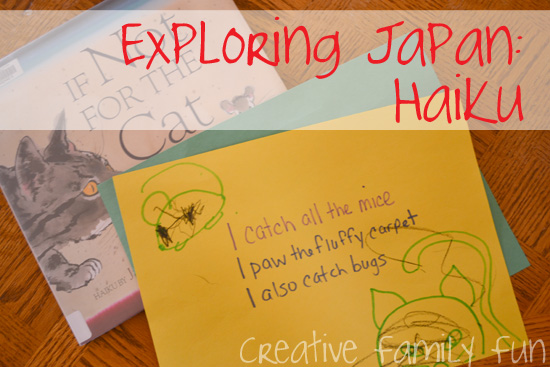
We chose the book If Not for the Cat by Jack Prelutsky for our example of haiku. The book consists of several haiku poems that describe different animals.

We had fun reading the poems and then guessing the animal it was describing.

What I loved about this book is that it was a great example of using just a few words to describe an animal. The girls could easily relate to the poems and were eager to try writing a few of their own.

I began by asking each girl to choose an animal. AJ (age 3) chose the cat and Lizzie (age 5) chose the butterfly.

We then helped each other come up with descriptive words and phrases to describe these animals.

Since the girls are still young, I helped them with the phrasing and formatting to fit within the 5-7-5 pattern.

If your child is already reading and writing, challenge them to write their own haiku in the 5-7-5 pattern.

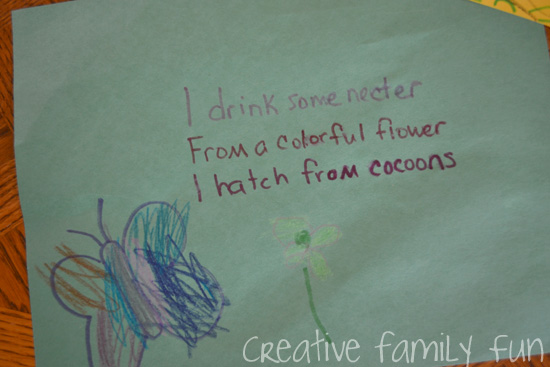
Once we had our haiku written, I had the girls illustrate their poems. (You may notice that AJ asked me to draw her a couple of pictures that she colored in.)

AJ (age 3)

I catch all the mice
I paw the fluffy carpet
I also catch bugs
 

Lizzie (age 5)

I drink some nectar
From a colorful flower
I hatch from cocoons

Have you spent any time exploring Japan through food, crafts, or other activity. If you have, we’d love for you to link up to Around the World in 12 Dishes!

Math Play: Square Hunt

July 5, 2012 By Terri Thompson

Our driveway shape maze wasn’t the only game we played while learning about squares.

We also went on a fun square hunt throughout the house.

The set-up for this game was easy. I took a sheet of paper and divided it into four areas. I then chose four room of our house.

You can do as many rooms as you would like and make your tally sheet as simple or as pretty as you like.

I just happen to like pretty.

Disclosure: There are Amazon Affiliate and other affiliate links in this article which means, at no additional cost to you, we could receive compensation for our recommendations. You can read our full disclosure policy on our Disclosure Page for more details.

We went room by room and the girls started hunting squares.

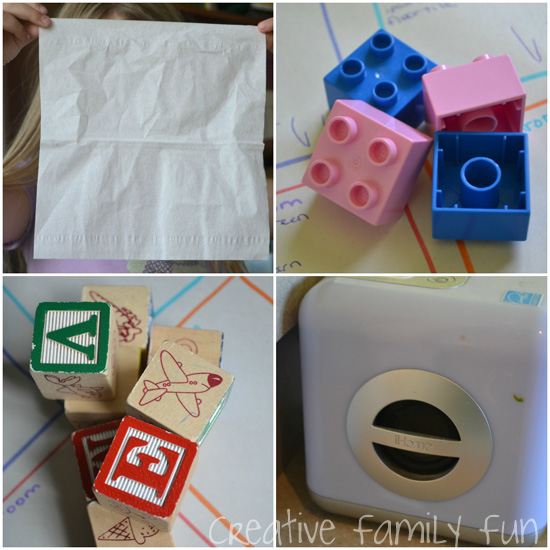
They found blocks, Kleenex, Duplos, my iPod dock, window panes, the TV screen, board books, baskets, boxes, and many more things.

Each time they found something I would add it to our list.

When we were finished with a room, we could count the items together.

Then Lizzie (age 5) was given the task of recording the number. I’ll take any excuse I can find to help her practice writing her numbers and letters.

Once we were finished with all of the rooms, we practiced a few more simple math concepts.

I asked the girls which room had the most squares and which room had the fewest squares. We then ranked the rooms from most to least.

You could also help the kids add all of the room totals together to find out just how many squares you found.

The variations to this game are endless. Hunt for circles or triangles. Hunt for a variety of shapes to see which one shows up the most at your house. Hunt for colors instead of shapes. Anything goes!

What variation of this game would you like to play with your kids?

Rhythm and Number Rhymes

June 25, 2012 By Terri Thompson

Clap, clap, clap, clap, clap, clap, clap…
“There were 10 in the bed and the little one said,
Roll over, roll over”

What is rhythm?

According to Dictionary.com, rhythm is a movement or procedure with uniform or patterned recurrence of a beat, accent, or the like. Rhythm is present in every song or piece of music.

It’s also present in many poems and nursery rhymes.

It can be simple or complicated. It may be composed of many different pauses and repetitions or just a simple standard, 1234, beat.

Disclosure: There are Amazon Affiliate and other affiliate links in this article which means, at no additional cost to you, we could receive compensation for our recommendations. You can read our full disclosure policy on our Disclosure Page for more details.

We recently explored rhythm through the use of the book, One, Two, Skip a Few! First Number Rhymes by Roberta Arenson.

This book is full of classic number rhymes that you may already be familiar with, such as “One potato, two potato” and “One, two, three, four, five, Once I caught a fish alive.”

All of the rhymes have a definite rhythm to them, which made this activity lots of fun.

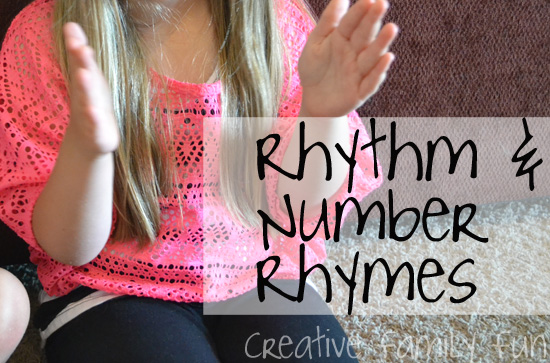
We started with simple clapping.

After we established a rhythm, we used the clapping to set our speed. We explored different speeds, trying fast and slow.

We also tried a simple leg pat. Pat, pat, pat, pat.

Once we mastered this simple rhythm, we moved on to something a bit more complicated and combined the claps and the pats.

Clap, pat, clap, pat, clap, pat…
“One, two, I love you,
Two, three, do you love me?”
 

Not only did we have fun, but we learned about a basic music term, rhythm.

We learned that rhythm can help us remember the words to a rhyme. We also learned to have a whole lot of fun and add a new dimension to nursery rhymes by providing the accompanying rhythm.

How do you use rhythm in your play?

Math Play: Kid-Made Counting Books

June 21, 2012 By Terri Thompson

I realized recently that a lot of the crafts and activities we’ve been doing have been geared towards my 5-year-old.

I realized that I needed to focus more on my 3-year-old with some of our activities.

My girls are at a point where their skills, interests, and educational needs are vastly different.

In light of this, I’ve made a goal to have a craft or activity each day that is geared towards each child’s levels, therefore, at least two things a day.

I’ll admit it’s a lofty goal and won’t always be achievable, but it has made me much more aware of the need to go back to learning some of the more basic ideas. Counting is one of those ideas.

We’ve checked out a fun variety of counting books from the library, we’ve gone on a counting walk, and we also made these fun counting books.

Disclosure: There are Amazon Affiliate and other affiliate links in this article which means, at no additional cost to you, we could receive compensation for our recommendations. You can read our full disclosure policy on our Disclosure Page for more details.

I was inspired by the pretty counting books on Living Montessori Now. I pinned it as soon as I saw it, knowing that I wanted the girls to make them someday. Deb provides a free printable if you don’t want to make your own pages. Our printer was completely out of ink, so we just made our own pages.

Supplies needed:

Construction paper
White paper
Scissors
Variety of stickers
Markers/crayons
Hole-punch
Yarn/ribbon/string

Our booklets were the size of a quarter sheet of paper.

I pre-cut all of the pieces of paper.

Each girl had 10 white pieces and 2 pieces of construction paper for the front and back covers.

On each sheet of paper, I drew a circle in the bottom corner for the girls to write their numbers. I had them write each number from 1 – 10 in the circles, then put the correct number of stickers on each page.

Lizzie (age 5) was able to work independently on her project, which gave me a chance to work with AJ (age 3).

She does very well with her counting, but is still in the pre-writing stage, so I wrote out all her numbers for her. This also gave me a chance to work with her on recognizing the written numeral.

When the pages were done, we punched a hole in the top corner of each page.

The girls put the pages in order and decorated the front covers of their book.

We then put a small length of yarn through the holes to bind the book together. (Keep the yarn a bit loose, so you can turn the pages easily). Voila! Fun and easy counting books!

Have you done any fun counting activities lately?

  • « Go to Previous Page
  • Page 1
  • Interim pages omitted …
  • Page 51
  • Page 52
  • Page 53
  • Page 54
  • Page 55
  • Interim pages omitted …
  • Page 61
  • Go to Next Page »

Primary Sidebar

Footer

Categories

Archives

Copyright © 2026 ยท Designed by The Blog Surgery

Creative Family Fun uses cookies to improve your experience. These cookies provide feedback to our analytics and advertisers. We use the information to track views of the site, where you go and to know if you are a regular visitor or brand new as well as provide a personalized experience where possible. We'll assume you're ok with this, but you can opt-out if you wish.Accept Reject Read More
Privacy & Cookies Policy

Privacy Overview

This website uses cookies to improve your experience while you navigate through the website. Out of these, the cookies that are categorized as necessary are stored on your browser as they are essential for the working of basic functionalities of the website. We also use third-party cookies that help us analyze and understand how you use this website. These cookies will be stored in your browser only with your consent. You also have the option to opt-out of these cookies. But opting out of some of these cookies may affect your browsing experience.
Necessary
Always Enabled
Necessary cookies are absolutely essential for the website to function properly. This category only includes cookies that ensures basic functionalities and security features of the website. These cookies do not store any personal information.
Non-necessary
Any cookies that may not be particularly necessary for the website to function and is used specifically to collect user personal data via analytics, ads, other embedded contents are termed as non-necessary cookies. It is mandatory to procure user consent prior to running these cookies on your website.
SAVE & ACCEPT